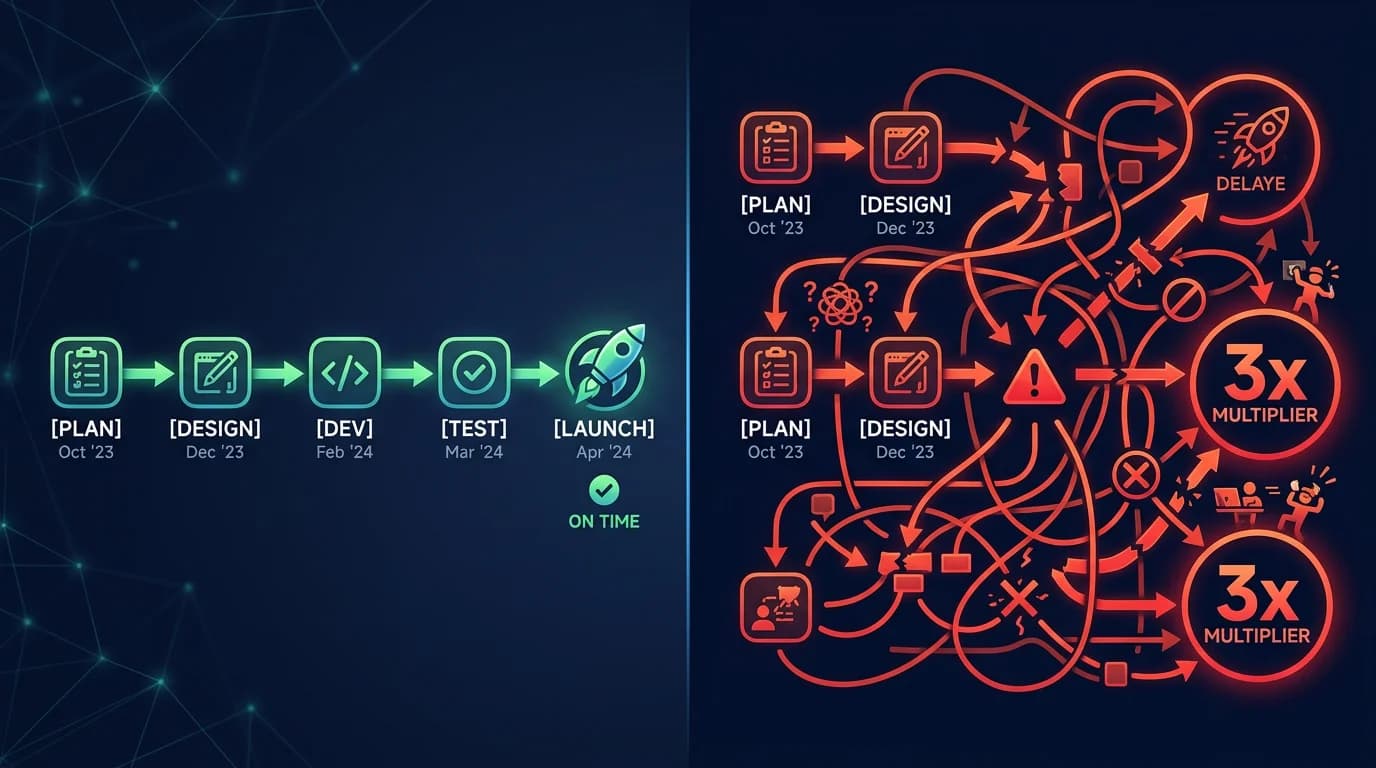
Why Your Bubble Migration Takes 3x Longer Than Quoted
The real reasons Bubble.io migrations blow past their timelines. Hidden workflows, undocumented privacy rules, plugin dependencies, and the discovery phase that agencies underestimate every time.
17 min read
You researched agencies. You checked references. You got three quotes and picked the one that felt right — 10 to 12 weeks to rebuild your Bubble.io app in custom code. Now you are in week 18, the budget is 60% over, and your developers keep finding things in Bubble they did not know existed.
This is not a story about bad developers or dishonest agencies. It is a story about a structural information gap that makes accurate Bubble migration estimates nearly impossible — unless you close it before the project starts.
The Timeline Problem Is Structural, Not Accidental
Software project overruns are not unique to Bubble migrations. Major IT-project research — including widely cited McKinsey/Oxford and Standish Group studies — has consistently found that large IT projects routinely run materially over budget and over schedule, with a non-trivial share going badly enough to threaten the sponsoring company. But Bubble migrations have a specific amplifier that generic software projects do not: the source code is invisible.
The Visibility Problem
When migrating from one codebase to another — say, Rails to Node.js — the developers can read the source. They can grep for every database query, trace every API call, and map every business rule. The codebase is text. It is searchable, auditable, and complete.
Bubble applications are not text. They are visual configurations stored in a proprietary format that cannot be exported, searched, or programmatically analyzed. The only way to understand a Bubble app is to click through the editor manually — every page, every workflow, every data type, every privacy rule — and document what you find. This is the job that nobody wants to do thoroughly, and the job that determines whether your migration timeline is accurate.
Why 3x and Not 2x
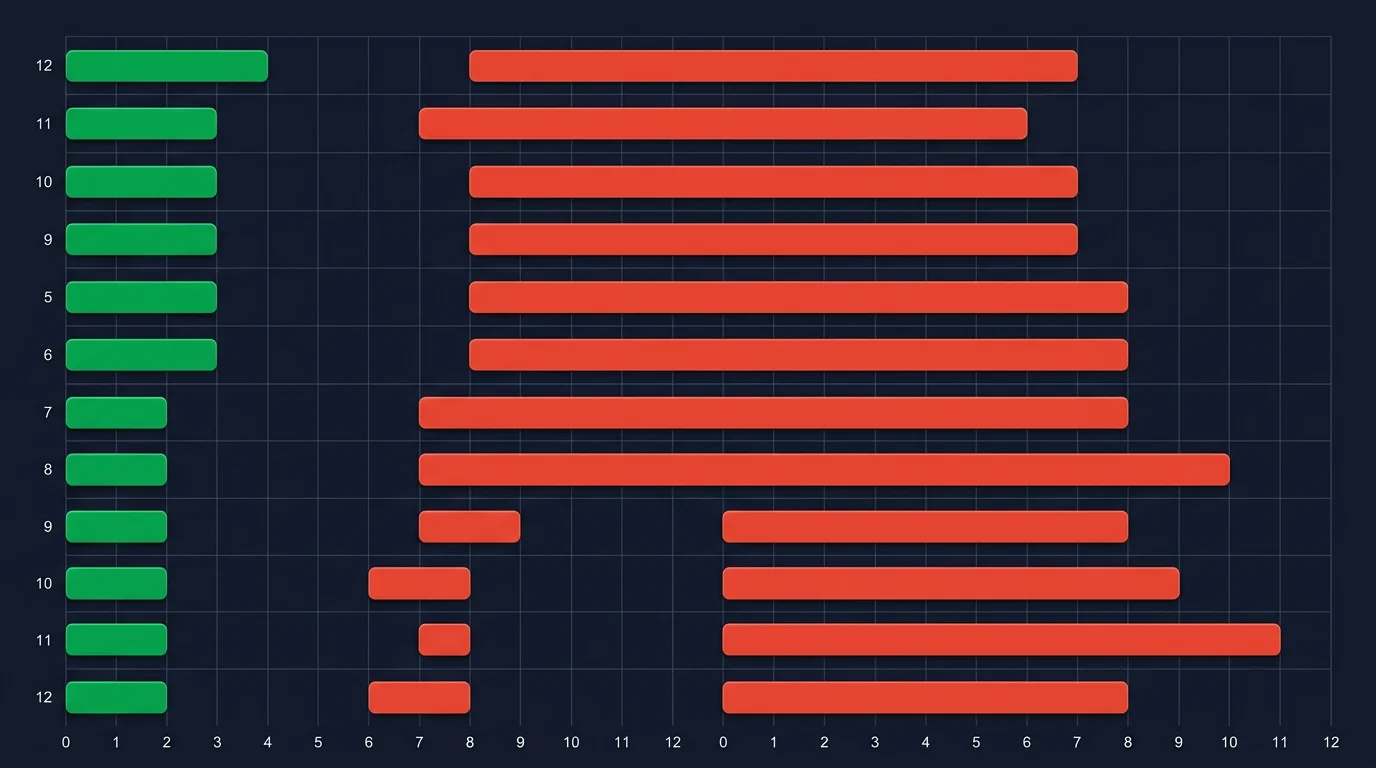
The overrun is not a simple linear underestimate. It compounds through three phases:
- Discovery delay: Undocumented features are found during development, adding 30% to 50% scope
- Rework cost: Code already written needs to be refactored to accommodate discoveries, adding 20% to 40%
- Testing extension: More features means more testing, more edge cases, more regression bugs — adding another 20% to 30%
These phases multiply. A discovery increase in the 30–50% range, layered with 20–40% rework and 20–30% testing extension, compounds to roughly 2x to 3x the original estimate in practice. Add coordination overhead and the typical optimism bias in initial scoping, and 3x is the median outcome we see for medium-complexity Bubble apps. The specific phase percentages above are illustrative compounding inputs, not measured stats — see the methodology note.
Why Agencies Underquote Bubble Migrations
Agencies are not intentionally misleading you. They are working with a broken estimation process that produces systematically low numbers. Here is how the typical scoping conversation goes.
The Standard Scoping Process
- You show the agency your Bubble app — usually a 30 to 60 minute screen share
- The agency sees the user-facing features: pages, forms, dashboards, reports
- They estimate based on what they saw — "X pages, Y features, Z integrations"
- They add a 20% buffer for unknowns
- They deliver a quote
What the Demo Misses
A screen share of your Bubble app shows the frontend — what users see and interact with. It does not show:
| Hidden Layer | Why It Is Missed | Impact on Timeline |
|---|---|---|
| Backend workflows (scheduled) | No visible UI — runs on timers | +2 to 4 weeks per complex workflow |
| Privacy rules | Invisible to end users | +1 to 3 weeks for rule translation |
| API Connector configs | Only visible in settings panel | +1 to 2 weeks per integration |
| Conditional workflows | Triggered by specific data states | +1 week per undiscovered path |
| Plugin-embedded logic | Hidden inside plugin black boxes | +1 to 3 weeks depending on plugin |
A 20% contingency buffer assumes you know 80% of the scope. In Bubble migrations where the backend is not visible, you typically know 50% to 60% of the scope at the time of quoting. A 20% buffer on a 50% scope understanding guarantees overrun.
The Five Discovery Failures
After analyzing case studies and developer reports from Bubble migration projects, five categories of late discovery account for the vast majority of timeline overruns.

Discovery 1: Scheduled Backend Workflows
Bubble allows you to schedule workflows that run at fixed intervals — every minute, every hour, every day at 3 AM. These workflows have no visible UI. They do not appear in any page or element list. They run in the background, processing data, sending emails, syncing records, and cleaning up expired entries.
A medium-complexity Bubble app typically has 5 to 15 scheduled workflows. Developers find them only when they dig into the backend workflow editor or when something breaks during testing because an expected background process is not running.
Discovery 2: Privacy Rules as Business Logic
In Bubble, privacy rules are not just access control — they are query filters. A privacy rule that says "Users can only see their own records" changes the behavior of every search on that data type. When you migrate to custom code, you need to replicate this filtering in every query, every API endpoint, and every background job that touches that data type.
The challenge is that privacy rules in Bubble are often more complex than the workflows themselves. Nested conditions like "User can see this record if they are in the record's team AND the team's plan is active AND the record is not archived OR the user is an admin" need to be translated into middleware, database queries, or row-level security policies.
Discovery 3: Implicit Data Relationships
Bubble's data model looks relational but is not. Fields can contain lists of other things (essentially arrays of foreign keys), creating many-to-many relationships without a join table. Fields can reference themselves recursively. And the "Search for" operator with constraints acts as an ad-hoc query builder that hides complex joins behind a simple interface.
When developers encounter these patterns during migration, they need to design proper relational schemas — join tables, foreign key constraints, indexes — that Bubble abstracted away. This schema design work was not in the estimate because the original assessment looked at data types, not data relationships.
Discovery 4: Plugin Replacement Complexity
Bubble plugins often encapsulate significant functionality behind a single "action" block. A payment plugin might handle subscription creation, proration calculation, dunning email scheduling, and webhook processing — all invisible in the workflow editor. When you remove the plugin during migration, you need to rebuild everything it was doing, not just the single action you saw in the workflow.
Common plugin replacements that blow timelines:
- Rich text editors with embedded image handling and sanitization
- PDF generation plugins that handle templating, styling, and file storage
- Geolocation plugins with distance calculations and map rendering
- Stripe plugins with subscription lifecycle management
Discovery 5: Conditional Element Visibility as Logic
Bubble developers frequently use element visibility conditions as business logic. An element that is "visible when Current User's role is Admin and Current Page Thing's status is Pending" is implementing an authorization check and a state machine transition — but it looks like a UI setting. During migration, these conditions need to become server-side logic, not just CSS display toggles.
- Scheduled backend workflows are consistently among the largest single sources of undiscovered scope in Bubble migrations because they have no UI footprint
- Privacy rule translation typically adds one to several weeks to medium-complexity projects, depending on rule depth and target stack
- Plugin replacement is the most variable category — a single complex plugin (subscription billing, rich-text editor, geolocation) can dominate multi-week segments of the timeline on its own
- Element visibility conditions are individually small but collectively add a non-trivial slice of scope once they have to become server-side authorization rules
The Compounding Cost of Late Discovery
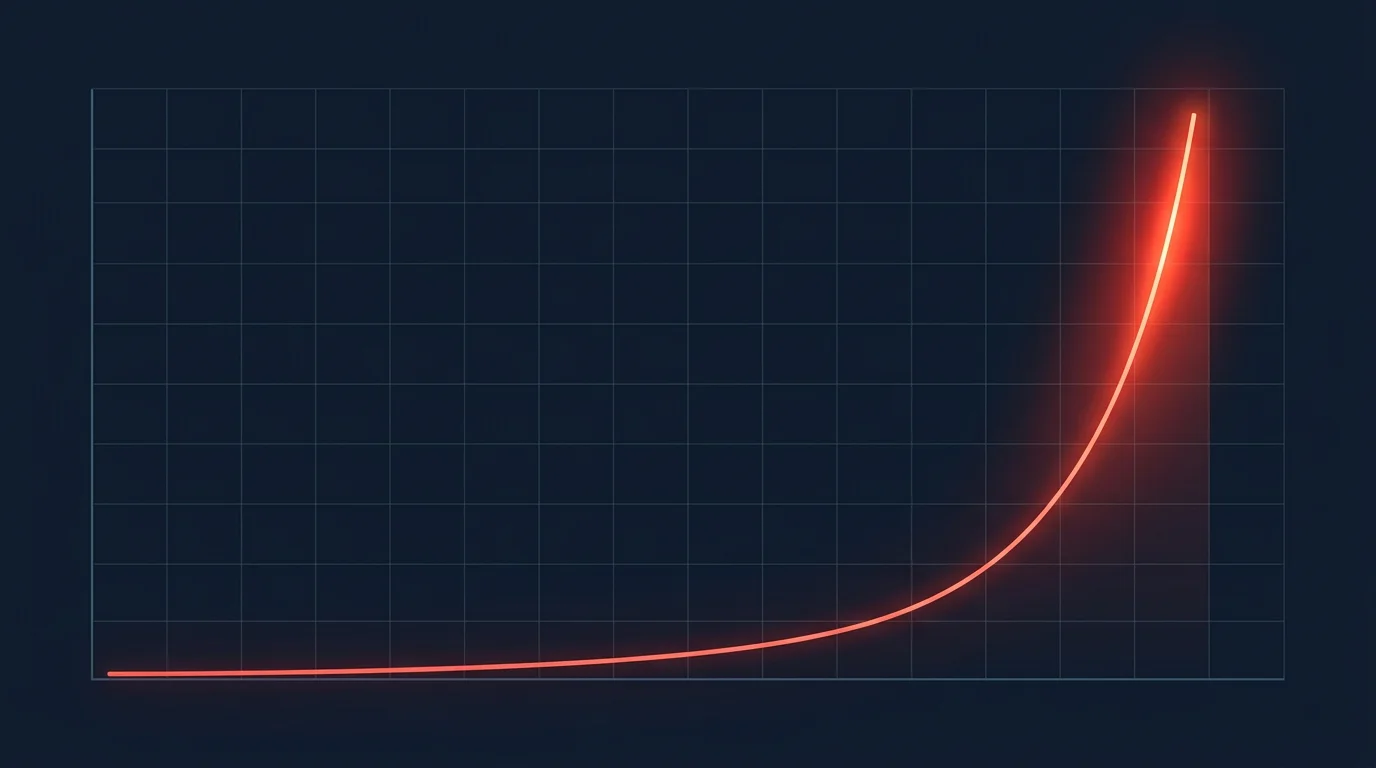
Finding a missing feature in week 2 of a project is cheap. Finding it in week 12 is expensive. The cost difference is not linear — it follows a well-documented pattern in software engineering.
The Rework Cascade
When a developer discovers a scheduled workflow in week 10 that cleans up expired tokens every hour, the impact is not just "add one more endpoint." The cascade looks like this:
- Design the token cleanup job for the new architecture
- Realize the job depends on a token expiry field that was not in the migrated schema
- Add the field to the database schema, write a migration script
- Update the token creation logic to populate the new field
- Update the authentication middleware that reads tokens
- Write tests for the cleanup job, the schema change, and the auth update
- Regression test everything that touches authentication
A single undiscovered workflow created seven tasks across four system layers. Multiply this by the 5 to 15 scheduled workflows in a typical app, and the timeline extension becomes clear.
The Team Coordination Tax
Late discoveries also impose coordination costs. When a developer finds something unexpected, they need to:
- Stop their current work to investigate
- Document the finding and communicate it to the team
- Wait for architectural decisions about how to handle it
- Potentially reassign work across team members
- Re-estimate the remaining timeline
Each discovery interrupts flow, resets context, and forces re-planning. In a 12-week project, three or four major discoveries can consume an entire week of calendar time just in coordination overhead.

How to Get an Accurate Migration Estimate
An accurate estimate requires knowing what you are estimating. That sounds obvious, but it is the step that most migration projects skip or rush.
The Pre-Estimate Audit
Before any agency or developer quotes a timeline, they need a complete inventory of your Bubble application:
| Category | What to Document | Typical Count (Medium App) |
|---|---|---|
| Data types | Fields, types, relationships, constraints | 15 to 30 types |
| Page workflows | Triggers, conditions, action sequences | 50 to 150 workflows |
| Backend workflows | Scheduled + API workflows | 5 to 20 workflows |
| API connections | Endpoints, auth, headers, response shapes | 3 to 10 connectors |
| Privacy rules | Per-type rules with conditions | 10 to 40 rules |
| Plugins | Functionality provided, dependencies | 5 to 15 plugins |
| App settings | Environment vars, roles, enums | 10 to 30 settings |
The Manual Audit Problem
A thorough manual audit of a medium-complexity Bubble app takes 40 to 120 hours. At $100 to $200 per hour, that is $4,000 to $24,000 just to understand what needs to be built — before any code is written. Most teams are unwilling to spend this, so they skip or abbreviate the audit, and the undiscovered scope shows up as timeline overruns instead.
This creates a perverse incentive: the step most critical to an accurate estimate is the step most likely to be cut from the budget.
The Architecture-First Approach
The solution to the 3x timeline problem is not better developers or more aggressive project management. It is closing the information gap before the project starts.

Automated Extraction
Relis automates the architecture audit that manual processes cannot make economical. It connects to your Bubble app with viewer-only access and extracts your complete backend architecture — database schemas, API specifications, backend workflow documentation, and app settings — into 9 standardized document types in under 10 minutes.
The extraction covers every layer that manual audits miss:
- All backend workflows — including scheduled ones with no visible UI
- Privacy rules — every condition, every data type
- API connector configurations — endpoints, auth methods, headers, response formats
- Data relationships — field-level connections, list fields, self-references
- App settings — environment configs, role definitions, enum values
From Blueprint to Accurate Quote
With a complete architecture blueprint, the estimation conversation changes fundamentally. Instead of "we saw 15 pages and 8 features in a demo," the conversation becomes "we have 22 data types with 147 fields, 12 backend workflows including 3 scheduled ones, 8 API connectors, and 34 privacy rules. Here is the spec for each."
Developers can now estimate from documentation, not from memory of a screen share. Edge cases are visible before the project starts. The 20% buffer becomes a genuine contingency rather than a placeholder for unknown scope.
The architecture documents from automated extraction are formatted for both human developers and AI coding tools. Teams feeding their ERD, API specs, and workflow documentation into AI assistants like Cursor or Claude commonly report a multiple-times speedup on core-feature implementation compared to building from scratch — the gap concentrates on schema scaffolding, API integration stubs, and background-job handlers, where structured input maps almost directly to generated code.
Frequently Asked Questions
Q. How do I know if my agency's migration quote is realistic?
Ask what their scoping process includes. If they estimated from a demo or screen share alone, the quote is likely 2x to 3x low. A reliable quote requires a documented inventory of your data types, workflows, API connections, privacy rules, and plugins.
Q. Should I do the architecture audit before or after selecting an agency?
Before. A complete architecture blueprint lets you get comparable quotes from multiple agencies based on the same specification. Without it, each agency is estimating from their own incomplete understanding — making quotes non-comparable.
Q. Can a good developer account for all the hidden complexity without an audit?
Experienced Bubble migration developers will catch more than inexperienced ones, but no developer can discover scheduled backend workflows or privacy rule configurations from a frontend demo alone. The information is simply not visible without accessing the Bubble editor directly.
Q. What percentage of a migration budget should go to the discovery phase?
For manual discovery, 10% to 15% of the total project budget is typical. With automated extraction, the cost drops to a fraction of that while producing more complete documentation. Either way, skipping discovery entirely costs far more in overruns.
Q. My agency said they have done Bubble migrations before. Is that enough?
Experience helps but does not eliminate the visibility problem. An experienced agency knows what to look for, but they still need access and time to find it. The question is whether their scoping process includes a thorough backend audit — not just frontend evaluation.
Fix the Estimate Before You Start
The 3x timeline problem is not inevitable. It is the predictable result of starting a migration without knowing what you are migrating. Every hour invested in architecture discovery before the project starts saves three to five hours of rework, re-estimation, and coordination overhead during the project.
The math is simple: a complete architecture audit costs a fraction of what a single week of timeline overrun costs in developer hours, delayed launch revenue, and team morale. Start with the blueprint. Get accurate quotes. Hit your timeline.
Get Your Architecture Blueprint in Minutes
Extract your complete Bubble backend — data schemas, API specs, backend workflows, privacy rules — before your agency writes a single line of code. Accurate estimates start with complete information.
Scan My App — FreeSee Your Bubble Architecture — Automatically
Stop reverse-engineering by hand. Relis extracts your complete database schema, API connections, and backend workflows in under 10 minutes.
See Your Bubble Architecture — Automatically
Stop reverse-engineering by hand. Relis extracts your complete database schema, API connections, and backend workflows in under 10 minutes.