How to Audit Your Bubble App Before Investors Ask
A 7-day self-audit playbook for Bubble.io founders heading into a pitch — five investor questions, a day-by-day audit schedule, and the documentation package you hand over.
20 min read
You scheduled a pitch with a venture firm next week. You built the product on Bubble.io. The deck is ready, the metrics are sharp, the founder narrative is dialed in — and the moment a technical advisor on the investor side opens your app, the conversation will pivot to a category of question you have probably not prepared for. How does the architecture scale? Where does the business logic live? Can you hand this to engineers if you need to? What does it cost to migrate?
This guide is the playbook for closing that gap in seven days. You will see the five questions investors actually ask about Bubble apps, a day-by-day audit schedule that fits inside one calendar week, the documentation package that turns the diligence conversation from defensive to confident, the red flags that trigger discount-the-valuation reactions, and the fallback when you do not have seven days. By the end you should be able to walk into the next pitch with a folder, not a fingers-crossed shrug.
Why Bubble Apps Get Extra DD Scrutiny
Investor diligence on a code-based startup is structurally simple: open the repo, run the test suite, read the architecture docs, talk to the engineering lead. None of those moves work the same way on Bubble — and the gap is where founders lose ground if they walk in unprepared.
The Three Friction Points
Bubble apps create three specific friction points during diligence. First, there is no source repository to clone — the .bubble export file is a proprietary backup format, not readable code. Second, the business logic lives in visual workflows that cannot be searched, version-controlled, or programmatically analyzed; an engineer reviewing the app has to click through the editor manually. Third, the architecture itself is invisible without a documented blueprint — you can show screens, but you cannot point to a data model, an API spec, or a workflow runbook.
What This Triggers in Diligence
Technical advisors on the investor side rarely call this out as "we discount Bubble apps." They reframe it as risk questions: scaling risk (can the platform handle your growth?), vendor risk (what happens if you need to leave?), and team risk (can a future engineering hire actually own this codebase?). Without prepared answers, founders end up improvising — and improvised answers to risk questions look exactly like risk.
What Strong Founders Do Differently
The founders who pass diligence on Bubble apps are not the ones who hide that they built on Bubble — they are the ones who can produce the same artifacts an investor would expect from a code-based product. Architecture diagram, API surface documentation, business-logic runbook, migration cost estimate, and a clear story for what triggers the move to custom code. Producing these in one week is a tractable problem; this guide walks through how.
The Five Questions Investors Will Ask
Across the Bubble-built fundraises we have seen, the same five questions surface in technical diligence. Prepare answers to these five and you have covered most of what gets asked.

Question 1 — What Does Your Data Model Look Like?
Investors want to see a data architecture diagram — types, fields, relationships. Bubble's data tab is not a substitute. The strong answer is an ERD (entity-relationship diagram) plus a one-page data dictionary explaining what each field means in business terms. If your data model has list fields creating implicit many-to-many relationships, name them — investors notice when founders pretend complexity does not exist.
Question 2 — How Does the App Scale?
This question rarely means "do you have load tests." It means "have you thought about workload-unit costs at 10x your current users, and what is your plan when the platform's economic ceiling arrives?" Strong answers reference real WU consumption numbers, the optimization runway you have, and the migration tipping point — our workload-units guide covers this math.
Question 3 — Who Owns the Code?
Bubble's application-ownership documentation is explicit that there is no way to export your app as code. Investors know this. The strong answer acknowledges it, then frames the migration path: when triggered, what does the rebuild look like, and what is the architecture artifact that powers it. Pretending the lock-in does not exist is the failure mode.
Question 4 — What Are Your Integration Dependencies?
Every external service your app talks to — Stripe, payment providers, email, analytics, CRM — represents an integration risk. The strong answer is an API specification document listing every connector, its endpoint surface, its authentication method, and its criticality. Founders who can hand over this doc skip an entire round of follow-up questions.
Question 5 — What Does It Cost to Migrate?
"At some point you will need to leave Bubble — what does that cost?" The strong answer is a range backed by an architecture audit (so the number is informed) and a clear timeline assumption. Vague answers ("we will figure it out when we get there") signal that the question has not been thought through. The cost framework in our migration cost guide is the right reference.
The Self-Audit — 7-Day Pre-Pitch Playbook
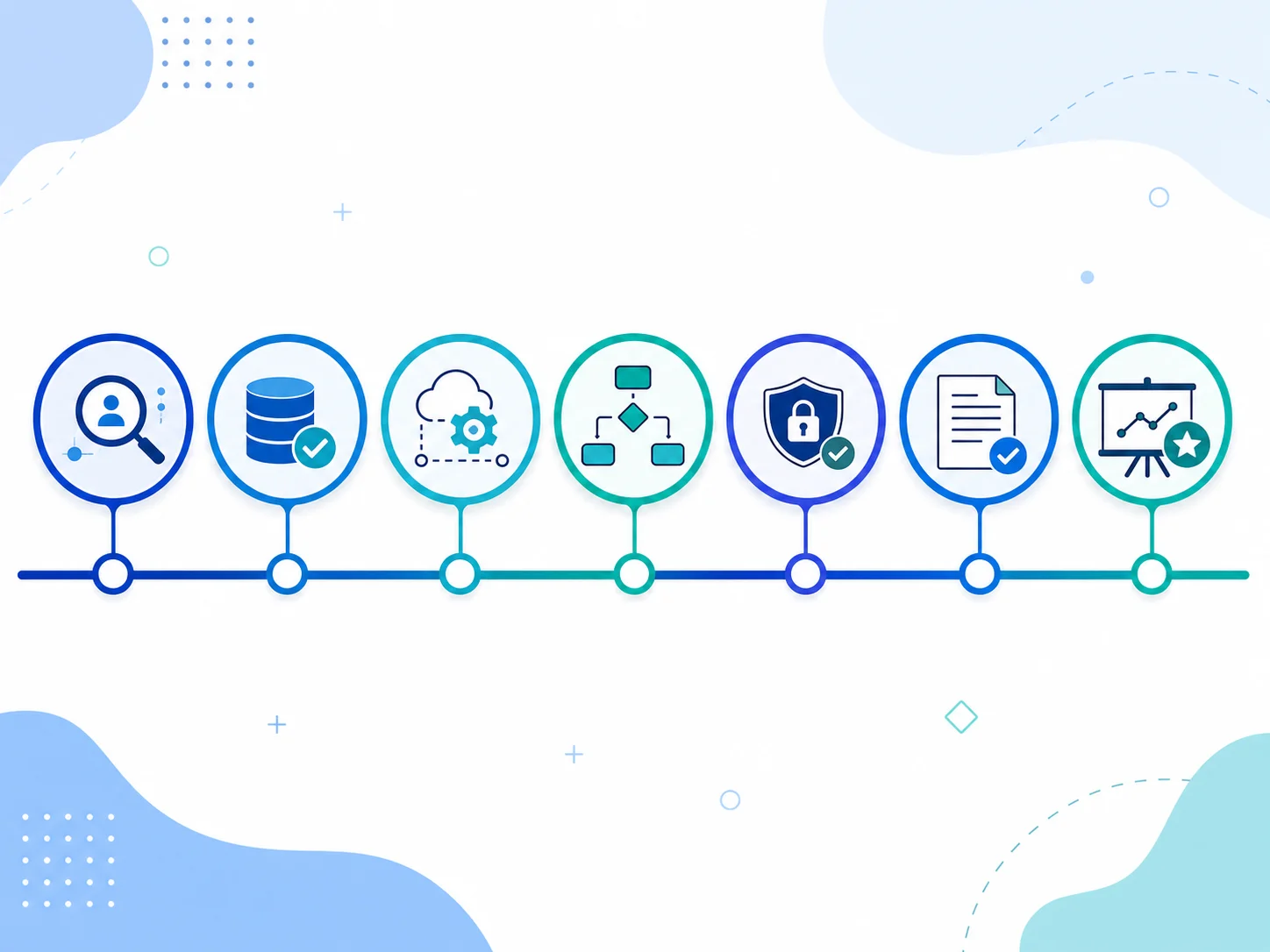
Seven days is enough time to produce every artifact above if you work in a structured order. Here is the day-by-day breakdown.
| Day | Focus | Output Artifact | Effort |
|---|---|---|---|
| Day 1 | Discovery & Inventory | Single inventory document covering pages, data types, API connectors, backend workflows, privacy rules | 3–5 hours |
| Day 2 | Data Architecture | ERD diagram + one-page data dictionary | 1–2 hours |
| Day 3 | API Surface & Integrations | API specification document (per integration) | 1–2 hours |
| Day 4 | Backend Workflows | Workflow runbook grouped by trigger type | 2–3 hours |
| Day 5 | Privacy Rules & App Settings | Privacy/permissions matrix + settings inventory | 1–2 hours |
| Day 6 | Synthesize & Stress-Test | Combined PDF/folder + stress-test review session | 2 hours |
| Day 7 | Pitch Ready | Cover memo + question-to-document mapping + Q&A rehearsal | 1–2 hours |
Day 1 — Discovery and Inventory
Open the Bubble editor and create a single document listing every page, every data type, every API connector, every backend workflow, and every privacy rule. You are not analyzing yet — you are counting. This document becomes the table of contents for everything else. Expect three to five hours; the work is mechanical but uncovers the scope of what you are about to document.
Day 2 — Data Architecture
Translate your inventory of data types and fields into an ERD. Use any tool that produces a clean diagram (dbdiagram.io, Lucidchart, Mermaid). Beside each entity, list its fields with types and any list-relationship notes. Write a one-paragraph data dictionary entry for each entity in business terms. Output: ERD diagram + one-page data dictionary.
Day 3 — API Surface and Integrations
For every API connector entry in Bubble, document the endpoint URL, authentication method, header configuration, request/response shape, and which workflows depend on it. Mark each integration's criticality (revenue-stopping, operational, analytical). Output: one-page API specification document covering every external integration.
Day 4 — Backend Workflows
Open the backend workflow editor and document each workflow's trigger (API-driven, scheduled, database-trigger), its action sequence, its conditional logic, and its data dependencies. Group workflows by trigger type. Pay particular attention to scheduled workflows — they are invisible from the page demo and represent the most common surprise during diligence. Output: a backend workflow runbook with one entry per workflow.
Day 5 — Privacy Rules and App Settings
Document every privacy rule on every data type, with the conditions in plain language. Output a privacy/permissions matrix (rows = data types, columns = roles). Then walk through the app's settings panel — domain configuration, environment variables, language settings, OAuth redirects — and produce a settings inventory. Output: privacy matrix + settings inventory.
Day 6 — Synthesize and Stress-Test
Assemble the four artifacts (ERD, API spec, workflow runbook, privacy matrix, settings inventory) into a single PDF or shared folder. Then run a stress test: ask a technical friend to spend an hour reviewing the package and pretending to be a diligence advisor. Capture every question they cannot answer from the documents — those are gaps to close before pitch day.
Day 7 — Pitch Ready
Final-pass the documentation package, prepare a one-page summary that maps each of the five investor questions to the relevant document, and rehearse the technical Q&A section of the pitch using only the package as your reference. If you can answer every question by pointing at a document, you are ready.
The Documentation Package You Hand Over
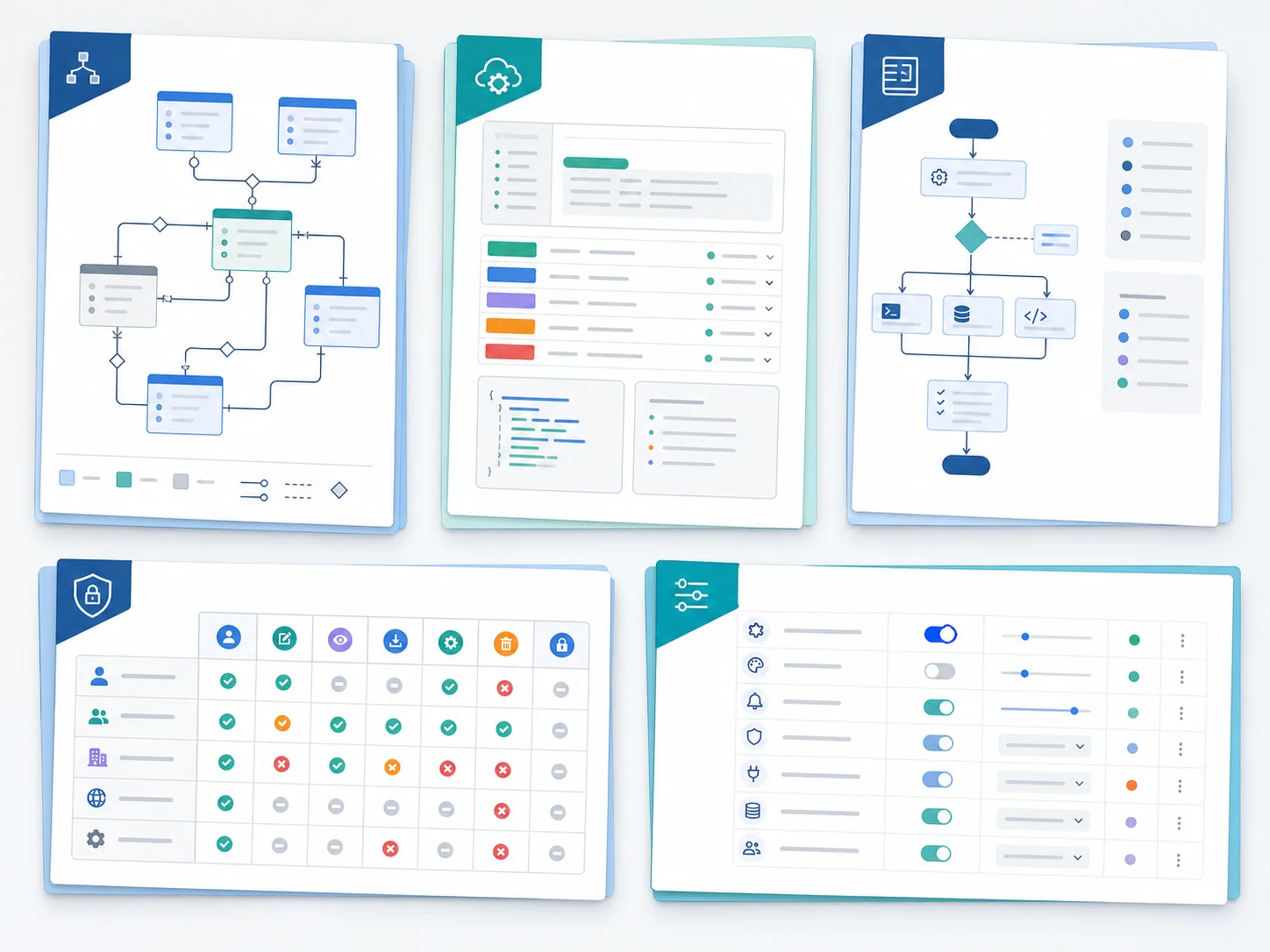
What does the deliverable look like when complete? A five-document package, in this order.
Document 1 — Architecture Overview (1 page)
One-page system diagram showing your app's components — Bubble runtime, database, API integrations, scheduled jobs, frontend. Include a short paragraph explaining what each component is responsible for. This is the first page diligence advisors read; spend disproportionate care on it.
Document 2 — ERD + Data Dictionary
The entity-relationship diagram from Day 2, paired with one-paragraph descriptions of each entity in business terms. The diagram answers "what is the schema?"; the dictionary answers "what does this represent?".
Document 3 — API Specification
List of every external integration with endpoint, auth, and criticality. Format like a developer-facing document, even if no developer is going to read it on the investor side; the format itself signals that the founder takes engineering rigor seriously.
Document 4 — Backend Workflow Runbook
One entry per backend workflow with trigger, conditions, action sequence, and dependencies. Group by trigger type — scheduled workflows in their own section because they are the most common diligence question.
Document 5 — Privacy Matrix and Settings Inventory
Privacy rules in matrix form (rows = data types, columns = roles), plus a settings inventory listing domain, environment variables, OAuth providers, and any other configuration that will need to move during a migration. This is the "operational ownership" document.
The Cover Memo (1 page)
A short one-page memo at the front of the package: "Here is the architecture overview. Here are the answers to the five common diligence questions. Here is our position on the migration question and the trigger conditions." Direct, no marketing tone. Investors read this first; everything else is appendix.
Red Flags Investors Spot Immediately
Even with the package above, certain founder behaviors trigger valuation discounts. Watch for these.
Pretending Bubble Is Not Bubble
"It is built on a custom JavaScript framework" is the most common version of this. Investors with technical advisors know within minutes. Acknowledge the platform, frame the architectural choice as a deliberate one for the stage of the business, and move directly to the migration story when relevant. Pretending introduces credibility risk that exceeds whatever you thought you were avoiding.
Vague Migration Cost Estimates
"It would cost a lot to migrate" or "we have not thought about it" both signal under-prepared founders. The strong answer is a number range backed by your architecture audit — "$X to $Y depending on whether we keep all features at parity, and the trigger condition is Z." Vague numbers feel like avoidance; specific ranges feel like ownership.
Hidden Workflow Complexity
If your demo and your workflow runbook tell different stories — say, the demo shows a simple checkout but the runbook reveals fifteen scheduled workflows handling subscription state — investor advisors will notice the gap and ask why it was not surfaced. Surface complexity yourself; do not let diligence find it.
"We Will Hire Engineers and It Will Be Fine"
This answer to "who owns the code" misunderstands the question. The right framing acknowledges that engineers cannot grep workflows, version-control changes, or run automated tests on a Bubble app — and that the migration architecture audit is the prerequisite to handing the codebase to engineers, not an afterthought. Founders who say this with confidence pass diligence; founders who say it as a hand-wave do not.
Over-Promising Compliance
"We are SOC 2 compliant because Bubble is" mis-states the relationship between platform compliance and application compliance. Bubble advertises platform-level certifications; your application's compliance posture is a separate matter that depends on your specific data flows and operational practices. Speak precisely about which layer is certified and which is not.
When You Cannot Audit in Time
Sometimes the pitch is in three days, not seven. Sometimes the team capacity for a manual audit just is not there. There is a path that compresses the timeline materially.

Automated Architecture Extraction
Relis extracts your full Bubble architecture — data schemas, API specs, backend workflow logic, privacy rules, and app settings — into nine standardized document types, typically in under ten minutes for medium-complexity apps. The output covers the same artifacts as the seven-day playbook above. The first three days of the manual playbook (discovery, data, APIs) compress into a single extraction run.
What Stays a Founder Job
Automated extraction does not produce the cover memo, the diligence-question mapping, or the migration cost narrative. Those remain founder work — but they are the work that benefits from focus, while the mechanical inventory is the work that benefits from automation. The combination produces a stronger package than either alone.
The Realistic Compressed Timeline
Day 1: extraction run plus stress-test review. Day 2: synthesize the package, write the cover memo, draft the migration cost narrative. Day 3: rehearse the technical Q&A. Three days produces a respectable package; one day is too tight even with extraction; seven days remains the gold standard if you have the calendar.
Frequently Asked Questions
Q. Do investors really care that I built on Bubble?
Most investors care less about the platform and more about whether you can answer the technical-risk questions clearly. The Bubble label triggers extra scrutiny because the architecture is harder to inspect; the scrutiny eases when the founder shows up with a documentation package that answers the questions in advance.
Q. What if my Bubble app does not have a clean architecture?
Most do not. The audit is what surfaces the messiness; the package is what frames it honestly. A founder who acknowledges architectural debt with a plan to address it is more credible than a founder who claims the app is clean. Diligence advisors see real apps regularly and recognize the difference.
Q. How long does the manual self-audit really take?
Seven calendar days at one to two focused hours per day works for medium-complexity apps. Larger or older apps can take longer because there are more workflows and integrations to document. The playbook compresses well — Day 1 is the longest, Days 6-7 are short — and most founders can fit it around an existing schedule.
Q. Should I hire an agency to do the audit for me?
An agency-led architecture audit can produce a polished package, but it costs materially more than founder-led work and the founder still has to absorb the contents to answer diligence questions. The hybrid model — automated extraction for the inventory, founder synthesis for the narrative — is usually the best cost-quality trade-off.
Q. Will an investor accept the documentation package as-is or will they want to talk to my engineer?
Most early-stage investors will accept the package and follow up with founder Q&A. Series A and later commonly bring in a technical advisor for a second pass — and the advisor will ask deeper questions but starts from your documents. Strong documentation reduces the advisor session from an open-ended interrogation to a structured review.
Q. What if I am not raising — should I still do this audit?
Yes. The same package serves three other future events: hiring your first engineer (the architecture overview is their onboarding doc), passing a customer security review (the privacy matrix and settings inventory are the artifacts), and planning a migration (the workflow runbook becomes the rebuild specification). The pre-pitch self-audit doubles as foundation documentation.
Audit Yourself Before They Audit You
- Bubble apps trigger extra diligence scrutiny because the architecture is harder to inspect: no source repo, no readable workflows, no programmatic audit. The friction is structural, not personal.
- Five questions cover most technical diligence: data architecture, scaling story, code ownership, integration dependencies, migration cost. Prepared answers to these five carry the diligence conversation.
- Seven days is enough for a manual self-audit: one artifact per day in dependency order produces the documentation package by Friday, leaving the weekend for rehearsal.
- The package is five documents plus a cover memo: ERD with data dictionary, API specification, backend workflow runbook, privacy matrix and settings inventory, and a one-page memo mapping investor questions to documents.
- The asset compounds: the same package serves future fundraises, hiring, security reviews, and migration planning. Cost amortizes across every event that asks the same questions.
The hardest moment in a diligence call is the one where you do not have the answer the technical advisor is looking for. The cheapest insurance against that moment is a documentation package you produce before they ask — and a week is enough time to produce it.
Ship the Package in Days, Not Weeks
If your pitch is closer than seven days away, automated architecture extraction compresses the inventory work into a single run. Get your full Bubble architecture — data, APIs, workflows, privacy rules, settings — into a developer-ready blueprint in minutes, then synthesize the cover memo yourself.
Scan My App — FreeYour Bubble App Has No Export Button — Until Now
Relis extracts your complete Bubble.io architecture automatically. ERD diagrams, DDL scripts, API docs, workflow specs — all in under 10 minutes.
Your Bubble App Has No Export Button — Until Now
Relis extracts your complete Bubble.io architecture automatically. ERD diagrams, DDL scripts, API docs, workflow specs — all in under 10 minutes.