Investor Due Diligence for Bubble Apps: What They Ask and How to Prepare
Investors ask about your code, your architecture, and your technical scalability. When your app runs on Bubble, those questions get harder. This guide covers the 8 due diligence questions investors and acquirers ask about no-code apps, how to answer them with architecture documentation, and when migration becomes a pre-requisite for funding.
18 min read
A meaningful share of no-code apps eventually migrate to custom code as they scale post-MVP — and for the subset of those apps that raise venture capital, the migration timeline is often accelerated by investor requirements rather than pure technical necessity. When a technical advisor opens your Bubble app — which is structurally a black box without exportable architecture — and sees a visual editor instead of a Git repository, the due diligence conversation changes fundamentally.
This is not because investors are anti-no-code. It is because their job is to assess risk — technical risk, vendor risk, scaling risk, and team risk. Bubble introduces a specific set of risks that do not exist with custom code, and investors need to understand how you are managing them. The founders who pass due diligence are not the ones who hide that they built on Bubble — they are the ones who can articulate exactly what their app does, how it scales, and what their migration path looks like.
Why Bubble Apps Get Extra Scrutiny from Investors
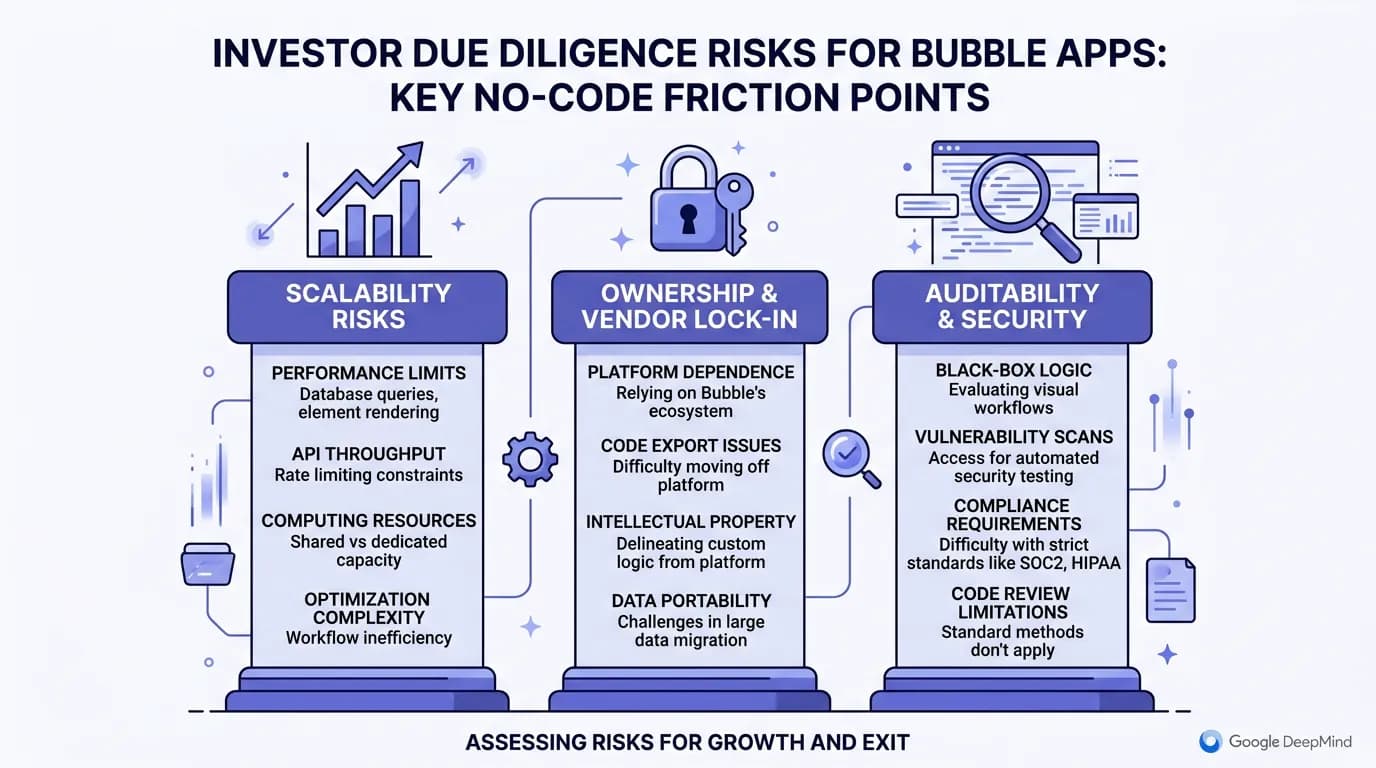
Investors evaluate three categories of technical risk: can the technology support the business at scale, does the team own and control the technology, and can the technology be audited and maintained. Bubble apps create friction in all three categories — not because Bubble is bad, but because its architecture makes these questions harder to answer.
The Auditability Problem
In a code-based startup, a technical advisor can clone the repository, read the code, assess the architecture, and identify risks in a few hours. With Bubble, the advisor must either get editor access (which many founders are reluctant to grant) or accept verbal descriptions of the architecture. Neither produces the confidence that reading source code provides. Architecture documentation bridges this gap — it gives advisors something to review without requiring editor access.
The Ownership Problem
You do not own your Bubble app in the way you own custom code. Bubble owns the runtime. Your logic exists in Bubble's proprietary format. You cannot move it to another host, fork it, or archive it in a way that survives Bubble's platform. This is not a deal-breaker for early-stage investments, but it becomes one as investment size increases and due diligence becomes more rigorous.
The 8 Due Diligence Questions Investors Ask
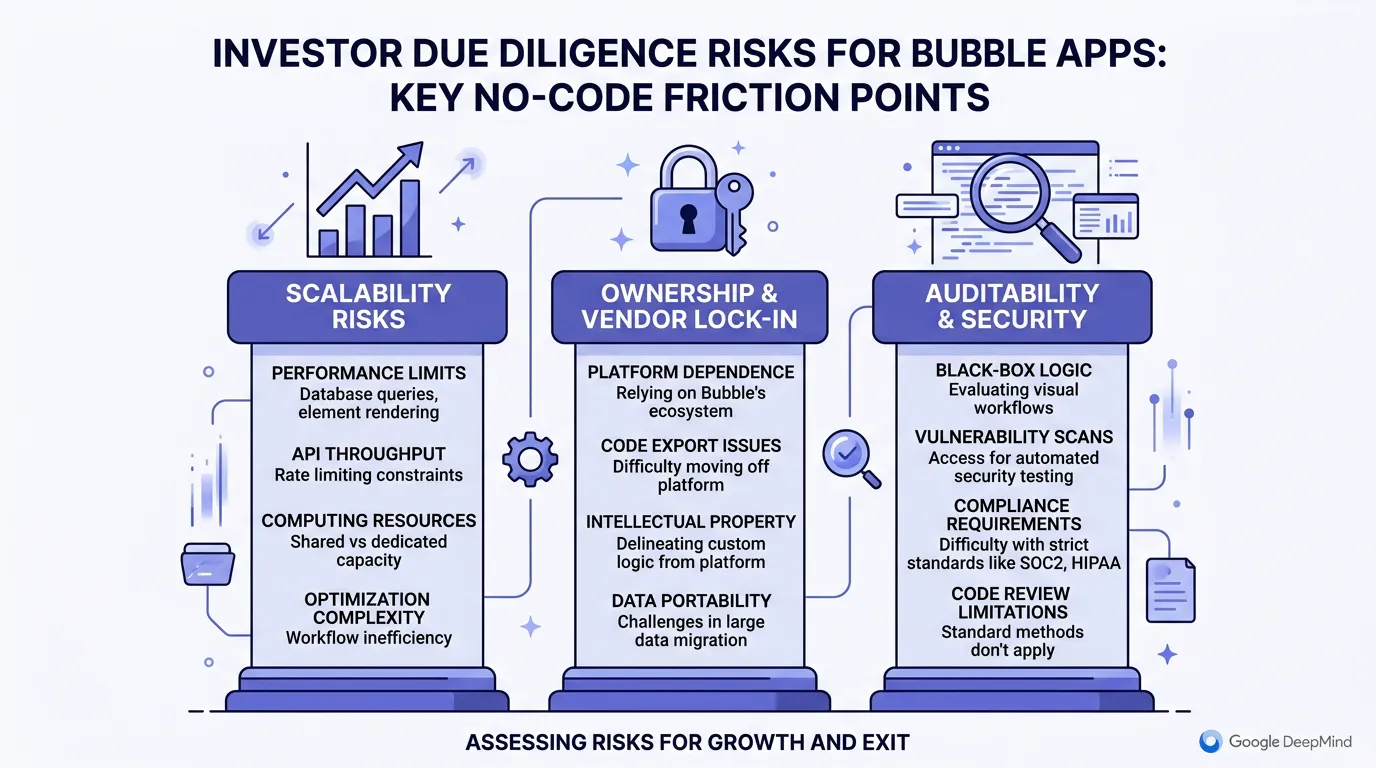
After analyzing due diligence frameworks from VC firms and technical advisors, eight questions consistently appear when the target company runs on a no-code platform.
| # | Question | What They Are Really Asking | Risk Level |
|---|---|---|---|
| 1 | Can I see the codebase? | Is the architecture reviewable and auditable? | High |
| 2 | What if Bubble shuts down? | Vendor dependency and business continuity risk | High |
| 3 | Can this scale to 10x users? | Is the architecture a ceiling or a foundation? | High |
| 4 | How is data secured? | Compliance readiness (SOC 2, HIPAA, GDPR) | Medium-High |
| 5 | Who owns the IP? | Can the code be transferred in an acquisition? | Medium |
| 6 | What is the migration plan? | Is there a credible path to custom code? | Medium |
| 7 | Can you hire developers for this? | Is the talent pool sufficient for growth? | Medium |
| 8 | What is the tech cost trajectory? | Will infrastructure costs scale linearly or exponentially? | Medium |
Question 1: Can I See the Codebase?
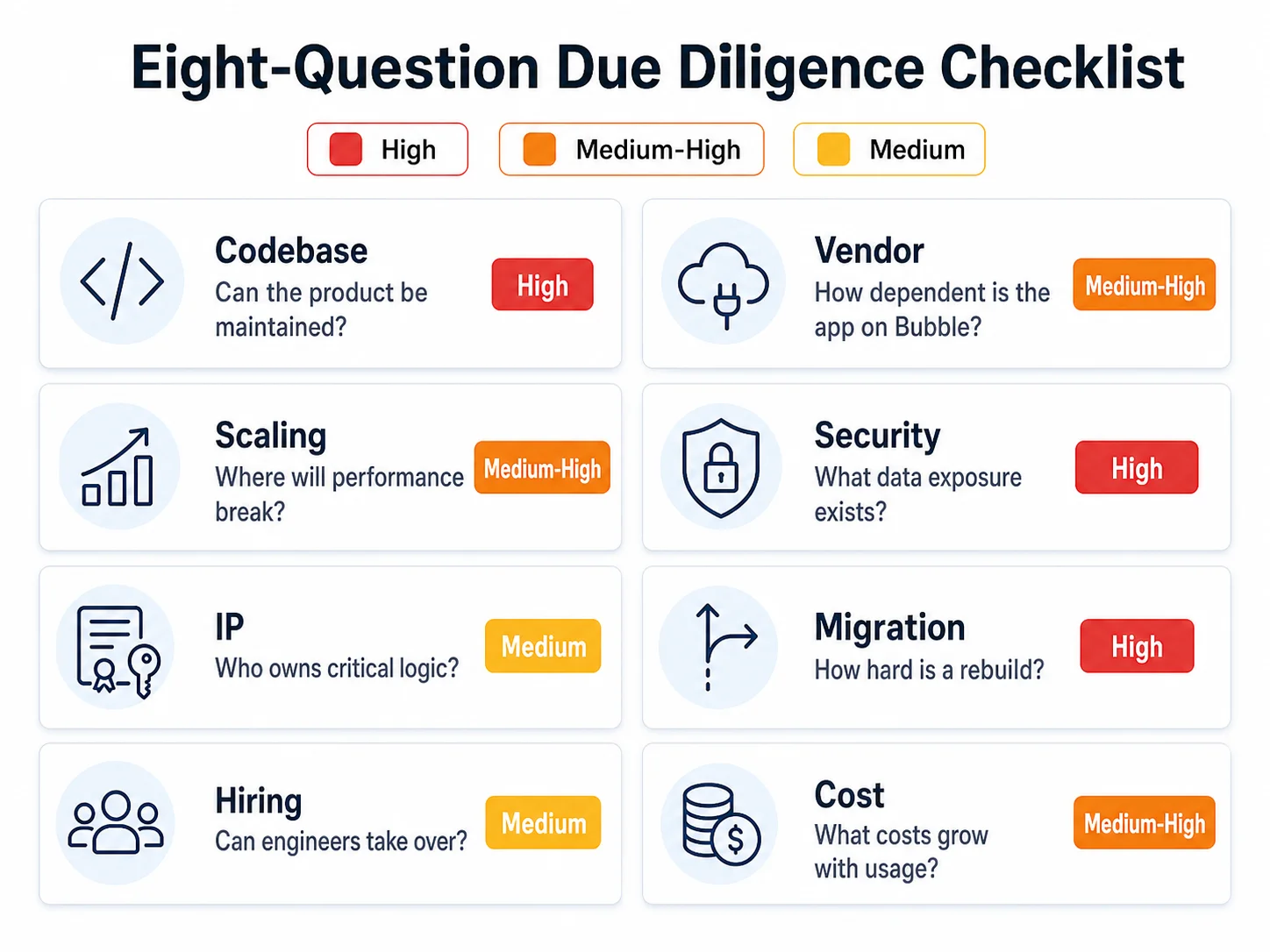
This is the question that stops most Bubble founders. There is no codebase to show. Bubble apps are visual configurations stored in a proprietary format. You cannot clone, export, or print your Bubble logic.
How to Answer
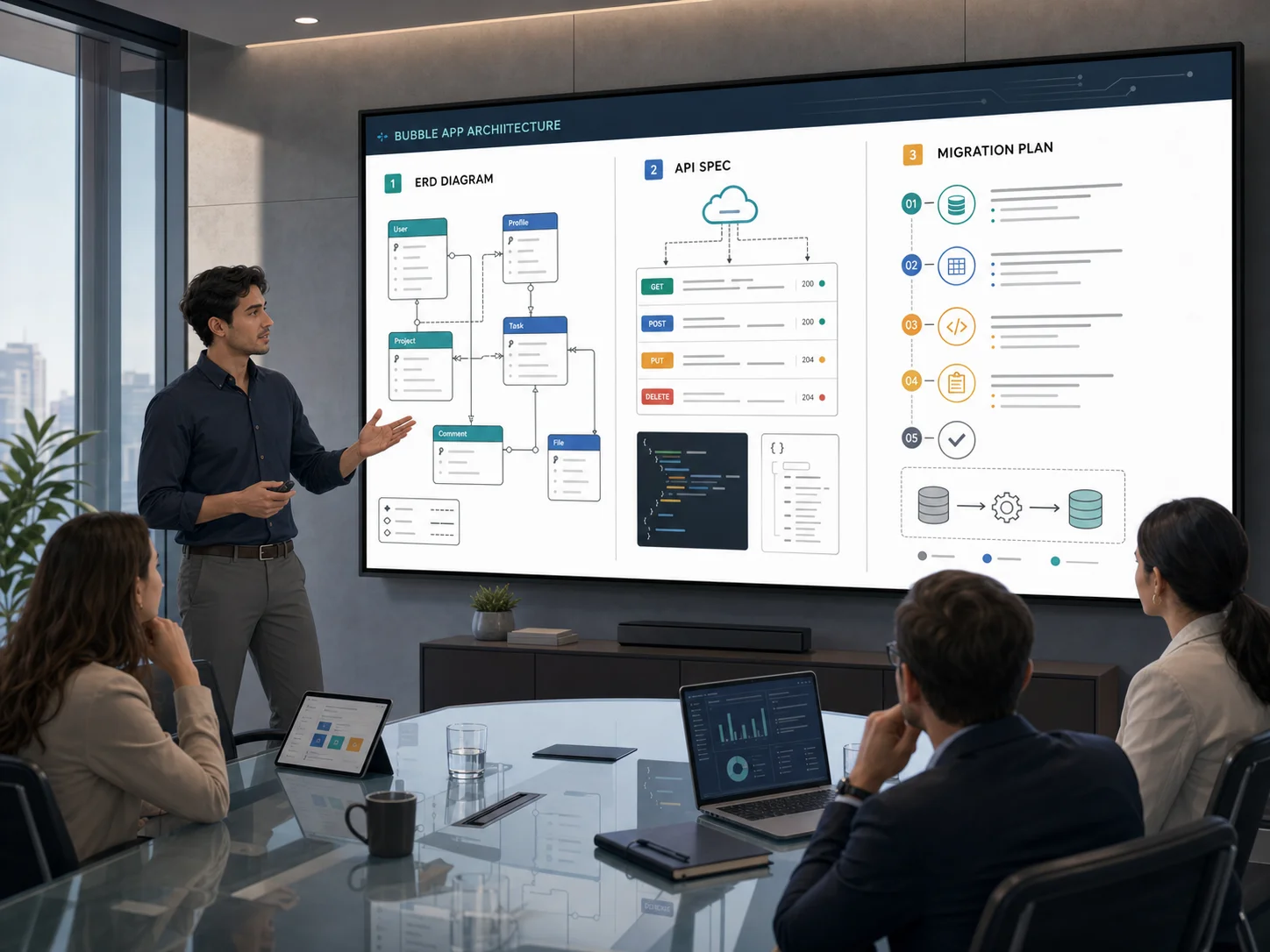
Provide architecture documentation instead. A comprehensive architecture blueprint — covering data schemas, API connector configurations, backend workflow logic, and privacy rules — gives technical advisors the same information they would extract from source code: how the data model works, what external services are integrated, what business logic runs server-side, and how access control is enforced.
This is not a workaround — it is often better than source code for due diligence purposes. Source code requires reading thousands of lines. Architecture documentation provides the structural overview that advisors actually need: "22 data types with 147 fields, 12 backend workflows including 3 scheduled ones, 8 API connectors with 23 endpoints, and 34 privacy rules."
What to Prepare
- ERD diagram: Shows every data type and relationship — equivalent to reviewing database migrations in a codebase
- API specification: Documents every external integration — equivalent to reviewing service client code
- Backend workflow documentation: Lists every server-side process — equivalent to reviewing job handlers and cron configs
- Privacy rule inventory: Documents access control logic — equivalent to reviewing authorization middleware
Relis generates all four documentation types — ERD, API specs, workflow docs, and privacy rules — in under 10 minutes. For due diligence, these documents demonstrate architectural maturity that many custom-code startups lack. Having structured architecture documentation is a signal of engineering discipline, regardless of the platform.
Question 2: What Happens If Bubble Shuts Down?
This is the vendor risk question. Investors want to know: if Bubble disappears tomorrow, does the business survive?
How to Answer
Be honest and prepared. Bubble is a well-funded company with a large user base — the risk of sudden shutdown is low. But the risk is not zero, and minimizing it is fair. Your answer should cover: data portability (you can export all user data via CSV and the Data API at any time), architecture documentation (you have a complete blueprint that enables rebuilding on any stack), migration timeline (based on your architecture complexity, a rebuild would take X weeks — reference the cost analysis), and migration readiness (you have a documented migration plan with a target stack identified).
The strongest answer includes a cost estimate: "Our architecture has been documented. Based on 22 data types, 12 backend workflows, and 8 API integrations, a migration would take 12 to 14 weeks and cost approximately $25,000 to $35,000. We have identified Next.js + Supabase as our target stack. We plan to migrate when we reach [specific trigger], not because of vendor risk."
Question 3: Can This Scale to 10x Your Current Users?
Investors model returns on 10x to 100x growth. If your technology cannot support that growth without a complete rebuild, the investment carries a hidden cost that reduces returns.
How to Answer
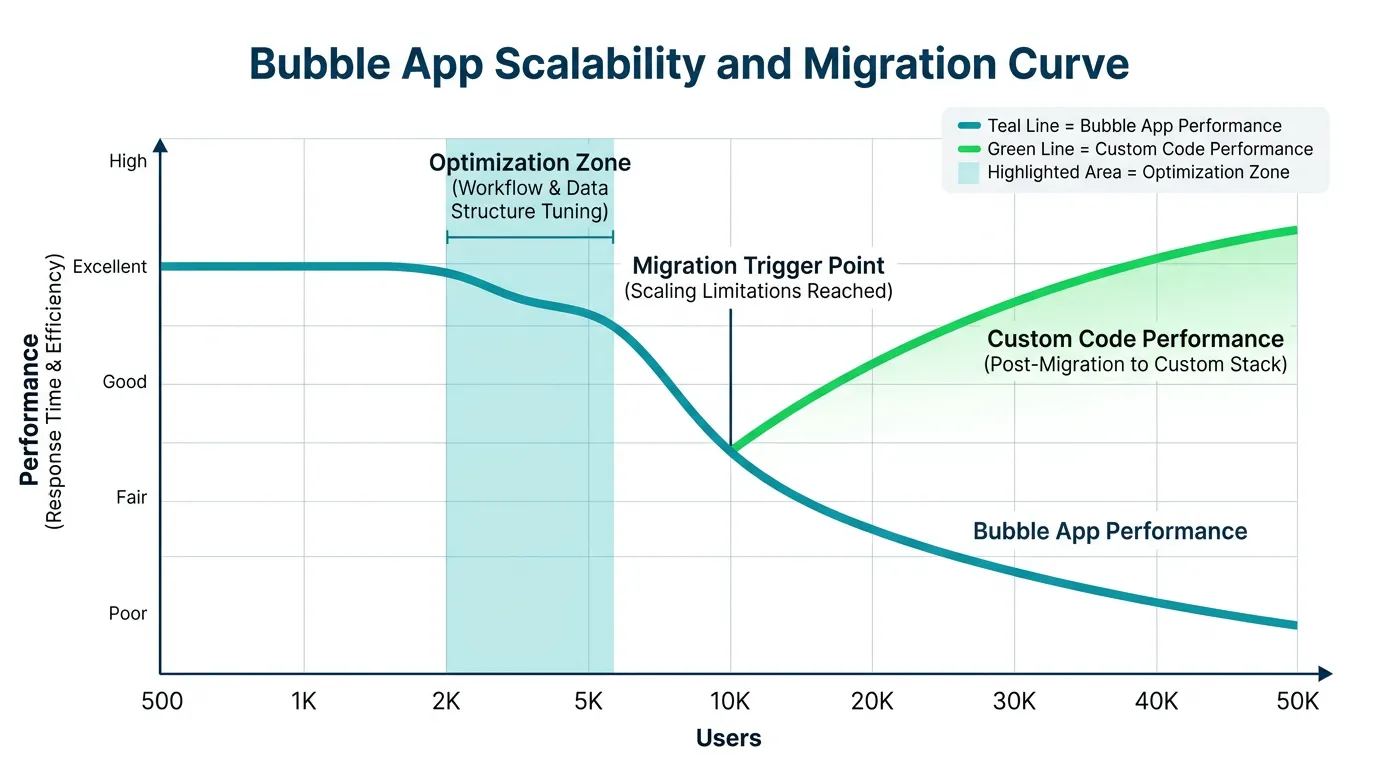
Differentiate between Bubble's limits and your app's architecture. If your app currently serves 500 users and an investor asks about 5,000: "Our current Bubble implementation handles 500 users well. Based on our architecture audit, the platform can support 2,000 to 3,000 users with optimization (privacy rules, search optimization, satellite data types). Beyond that, we plan to migrate — our architecture documentation provides the migration specification. The migration is budgeted at $X and planned for Q[X]."
This answer demonstrates: you understand your platform's limits (technical maturity), you have a quantified plan to address them (execution capability), and the investment can fund the migration if needed (capital efficiency).
Questions 4–8: Security, IP, Team, and Compliance
Question 4: How Is Data Secured?
Bubble provides: SSL/TLS encryption in transit, data encryption at rest, SOC 2 Type II compliance (Bubble's infrastructure), and privacy rules for access control. Document your privacy rule architecture to show that you have intentional access control, not default-open data. For regulated industries (healthcare, finance), acknowledge that Bubble may not meet HIPAA or PCI requirements and reference your migration plan for when compliance becomes mandatory.
Question 5: Who Owns the IP?
You own the business logic, the design, and the data. You do not own the runtime (Bubble's platform) or the ability to export your logic in a portable format. In an acquisition scenario, the acquirer would need to either continue running on Bubble or fund a migration. Having architecture documentation ready makes the acquisition due diligence significantly smoother — the acquirer can estimate migration cost before making an offer.
Question 6: What Is the Migration Plan?
The strongest answer is a documented plan with: target stack (e.g., Next.js + Supabase), trigger conditions (e.g., 5,000 DAU or SOC 2 requirement), timeline estimate (e.g., 12 to 16 weeks based on architecture complexity), cost estimate (e.g., $25K to $40K based on documented scope), and team plan (in-house, agency, or hybrid). A vague "we will migrate when we need to" is a red flag. A specific plan with numbers is a green flag.
Question 7: Can You Hire Developers for This?
Bubble has a growing but still niche talent pool. For scaling the team post-investment, acknowledge this and pivot: "Our current team manages the Bubble implementation. Post-migration, we will hire from the [Next.js / React / Python] talent pool — one of the largest in software development. Our migration plan includes team scaling from 2 to 5 developers."
Question 8: What Is the Tech Cost Trajectory?
Show the math. Current Bubble costs (plan + WU overages + plugins): $X/month. Projected cost at 3x users: $Y/month. Post-migration hosting cost: $Z/month. The workload unit analysis provides the data for this calculation. If the cost trajectory shows exponential growth on Bubble versus linear growth on custom hosting, the migration ROI case makes itself.
| Question | Preparation Required | Document to Provide |
|---|---|---|
| Codebase review | Architecture extraction | ERD, API specs, workflow docs, privacy rules |
| Vendor risk | Data export plan + migration estimate | Migration plan with timeline and cost |
| Scalability | Performance audit + optimization roadmap | Performance baseline + growth plan |
| Security | Privacy rule documentation | Access control specification |
| IP ownership | Architecture documentation | Complete architecture blueprint |
| Migration plan | Target stack + timeline + cost | Migration roadmap document |
| Hiring | Post-migration team plan | Team scaling roadmap |
| Cost trajectory | WU analysis + hosting comparison | Cost projection spreadsheet |
When Migration Becomes a Funding Prerequisite
At certain funding stages, investors do not just ask about migration — they require it. Understanding where this threshold falls helps you time your migration to align with your fundraising timeline.
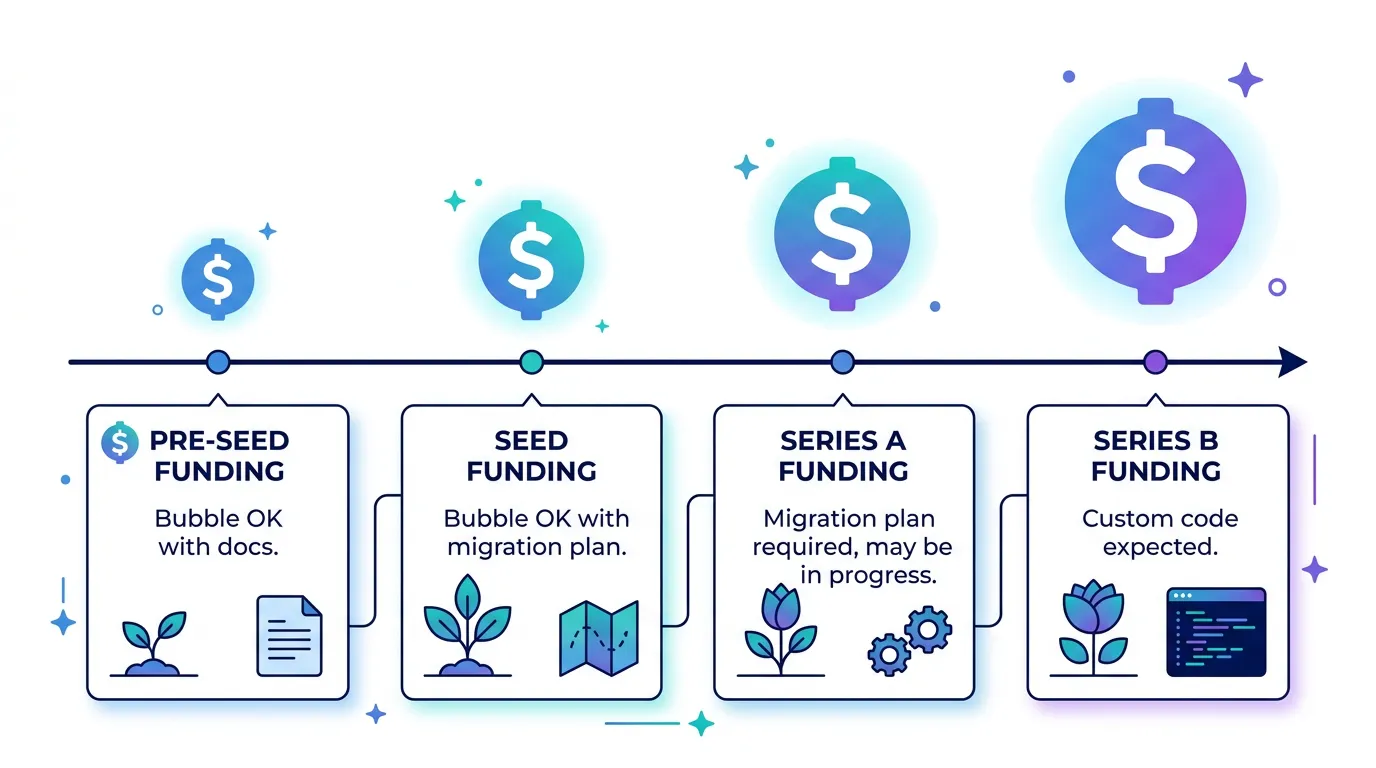
Pre-Seed and Seed: Bubble Is Usually Fine
At pre-seed and seed stages, investors care about product-market fit, not platform choice. A working product with paying users on Bubble is stronger than a half-built product on custom code. Have architecture documentation ready for the question, but do not migrate preemptively.
Series A: Migration Plan Required
At Series A, investors expect a credible technical scaling plan. This usually means: documented architecture, quantified migration plan (timeline and cost), and either migration in progress or a specific trigger defined. A strong Series A answer: "We validated on Bubble, we have complete architecture documentation, and our migration begins in Q[X] targeting Next.js + Supabase."
Architecture documentation is a one-time investment that pays off across every investor conversation. Extract your complete Bubble architecture — data schemas, API integrations, backend workflows, and privacy rules — before due diligence starts. A 10-minute extraction with Relis produces documents that answer four of the eight standard due diligence questions without a single follow-up call.
Series B and Beyond: Custom Code Expected
By Series B, most investors expect the product to run on custom code or be in active migration. The rare exceptions are companies whose products do not require scale (internal tools, low-traffic B2B) or companies that have proven Bubble can handle their specific scale requirements. For most SaaS companies, Series B fundraising is the forcing function for migration completion.
Some investors reflexively suggest migration without understanding your product or your metrics. If your app serves its users well on Bubble, your costs are manageable, and your growth does not require migration, push back with data. Show the cost analysis, the performance metrics, and the migration plan. The best investors evaluate evidence, not platform bias. Migrate when the data says you should — not when an advisor who has never seen your architecture suggests it.
Frequently Asked Questions
Q. Have Bubble-based startups successfully raised funding?
Yes. Multiple startups have raised seed and Series A rounds while running on Bubble. Bubble's own showcase and case-study pages list publicly named examples; we omit specific company names here to avoid asserting funding details we have not independently verified. The key is demonstrating product-market fit, presenting a credible technical plan, and having architecture documentation that makes the technology reviewable. Bubble is not a disqualifier — lack of preparation is.
Q. Should I mention Bubble proactively or wait for the question?
Proactively. Trying to hide your platform choice erodes trust when it is discovered — and it will be discovered during technical due diligence. Frame it positively: "We built on Bubble to validate quickly, we have paying users proving product-market fit, and we have a documented migration plan for scale." This demonstrates pragmatic decision-making, not technical weakness.
Q. How much does it cost to prepare for technical due diligence?
Automated architecture extraction: under $100 and 10 minutes. Adding a migration plan document: 1 to 2 days of founder or CTO time. Performance audit with optimization recommendations: $1,000 to $3,000. Total preparation cost: $1,000 to $3,000 and 1 to 2 weeks. This is negligible compared to the fundraising amount at stake.
Q. What if the investor's technical advisor has never seen a Bubble app?
Most technical advisors have not. This makes architecture documentation even more critical — it translates your Bubble architecture into familiar terms (ERD diagrams, API specs, workflow documentation) that any senior developer can evaluate. Without documentation, the advisor must either learn Bubble's editor or rely on your verbal explanation. Neither inspires confidence.
Q. Does running on Bubble affect my valuation?
It can, at later stages. Some investors apply a "migration discount" — reducing valuation by the estimated migration cost ($20K–$60K). At pre-seed, this is negligible. At Series A, it might reduce a $5M valuation by 1 percent — not material. The bigger impact is on conviction: investors who cannot evaluate your technology have less confidence, which affects term sheet competitiveness more than valuation arithmetic.
Q. Should I migrate before fundraising to avoid these questions?
Only if migration is already justified by your product needs (performance, compliance, scale). Migrating solely to impress investors wastes 3 to 5 months and $20K to $60K that could fund growth. The smarter approach: document your architecture, prepare your migration plan, and present both during due diligence. Investors fund traction, not tech stacks.
Prepare Before the Question Is Asked
- Architecture documentation replaces source code for due diligence: ERD diagrams, API specs, workflow docs, and privacy rules give technical advisors the same structural understanding they would get from reading a codebase — often in a more accessible format.
- Eight questions, eight prepared answers: Codebase, vendor risk, scalability, security, IP, migration plan, hiring, and cost trajectory. Prepare documented answers for each before the conversation, not during it.
- The migration plan is your strongest asset: A specific plan with target stack, trigger conditions, timeline, and cost demonstrates engineering maturity. A vague "we will migrate eventually" is a red flag that suggests you have not thought about scale.
- Funding stage determines migration urgency: Pre-seed and seed — Bubble is fine with documentation ready. Series A — migration plan required. Series B — custom code expected. Time your migration to align with your fundraising roadmap.
- Do not migrate to impress — migrate to scale: Architecture documentation and a credible plan satisfy investor due diligence without premature migration. Spend your runway on growth, not on migrating a platform that still serves your users well.
The founders who pass technical due diligence are not the ones running the fanciest stack. They are the ones who understand their architecture, quantify their risks, and have a credible plan for the future. Extract the documentation. Prepare the answers. Let your traction speak for itself.
Prepare for Due Diligence in Minutes
Relis extracts your complete Bubble architecture — data schemas, API specs, backend workflows, privacy rules — into investor-ready documentation. Answer every technical question with data, not hand-waving.
🚀 Scan My App — FreeSee Your Bubble Architecture — Automatically
Stop reverse-engineering by hand. Relis extracts your complete database schema, API connections, and backend workflows in under 10 minutes.
See Your Bubble Architecture — Automatically
Stop reverse-engineering by hand. Relis extracts your complete database schema, API connections, and backend workflows in under 10 minutes.