
How to Vet a Bubble Migration Agency: The 10-Question Checklist
A practical vetting framework for non-technical founders hiring a Bubble.io migration agency. Covers the 10 questions that separate reliable partners from expensive mistakes — with red flags, green flags, contract structures, and real cost data.
18 min read
You have decided to migrate off Bubble following a migration roadmap, budgeted based on realistic cost estimates, and maybe even chosen a tech stack. Now comes the decision that determines whether those plans survive contact with reality: who builds it?
The migration agency market is a minefield. Quotes for the same app range from $5,000 to $80,000. Timelines range from "two weeks" to "six months." Some agencies deliver production-ready code. Others deliver a half-finished prototype and an invoice for change orders. The difference is not obvious from a portfolio page — it only becomes clear when you ask the right questions. This guide gives you those questions.
Why Most Agency Relationships Fail Before Code Is Written
Migration project failures rarely stem from bad code. They stem from bad scoping. Software-project retrospectives consistently find that the majority of projects that skip a structured discovery phase exceed their budget — and for migrations, the gap is wider still, because legacy systems always contain undocumented logic.
The Discovery Gap
Bubble apps accumulate complexity invisibly. Background workflows, conditional privacy rules, plugin-dependent behaviors — none of these are visible from the frontend. An agency that quotes without auditing this hidden layer is guessing. And when their guess is wrong, you pay the difference through change orders, timeline extensions, or — worst case — a failed migration you cannot ship.
The Quote Spread Problem
When three agencies quote $15K, $40K, and $80K for the same app, they are not quoting the same work. The $15K agency is quoting what they see on screen. The $40K agency is quoting what they see plus some buffer for surprises. The $80K agency — if they are good — is quoting after actually auditing your app's backend. The irony: the most expensive quote is often the most accurate, while the cheapest quote is the one most likely to double.

The 10-Question Vetting Checklist
Ask every candidate these questions — in order. Their answers reveal more about their process than any case study or portfolio ever could.
Question 1: "Walk me through your discovery process."
This is the single most important question. A good answer describes a structured one-to-two-week audit that produces documented deliverables: a requirements document, a data audit report, an architecture recommendation, and a risk assessment. A bad answer is "we can start building immediately" or "discovery is included in development." Discovery that does not produce a standalone document is not real discovery — it is guessing with extra steps.
Question 2: "How do you find hidden backend logic?"
Bubble apps store critical business logic in backend workflows, scheduled tasks, and privacy rules that are invisible from the UI. A competent agency will mention exporting your Bubble app JSON, auditing production data, and testing integrations end-to-end. An agency that says "we will figure it out as we go" will figure it out on your budget.
Question 3: "Can you show me live apps you have migrated?"
Screenshots and case studies prove nothing. Live URLs let you test performance, responsiveness, and actual functionality. Ask for three references from comparable migration projects — not just web development projects, but specifically no-code-to-custom-code migrations. If they cannot provide them, they have not done this before.
Question 4: "What is your payment schedule?"
The answer reveals their confidence and your risk exposure. Milestone-based payments — where each payment is tied to a specific deliverable — protect both parties. Front-loaded terms (50 percent or more upfront) remove the agency's incentive to deliver on time. The industry best practice is: 20 to 25 percent at signing, 30 percent at architecture approval, 30 percent at feature-complete, and 20 percent after launch and a 30-day warranty period.
Question 5: "How long will this realistically take?"
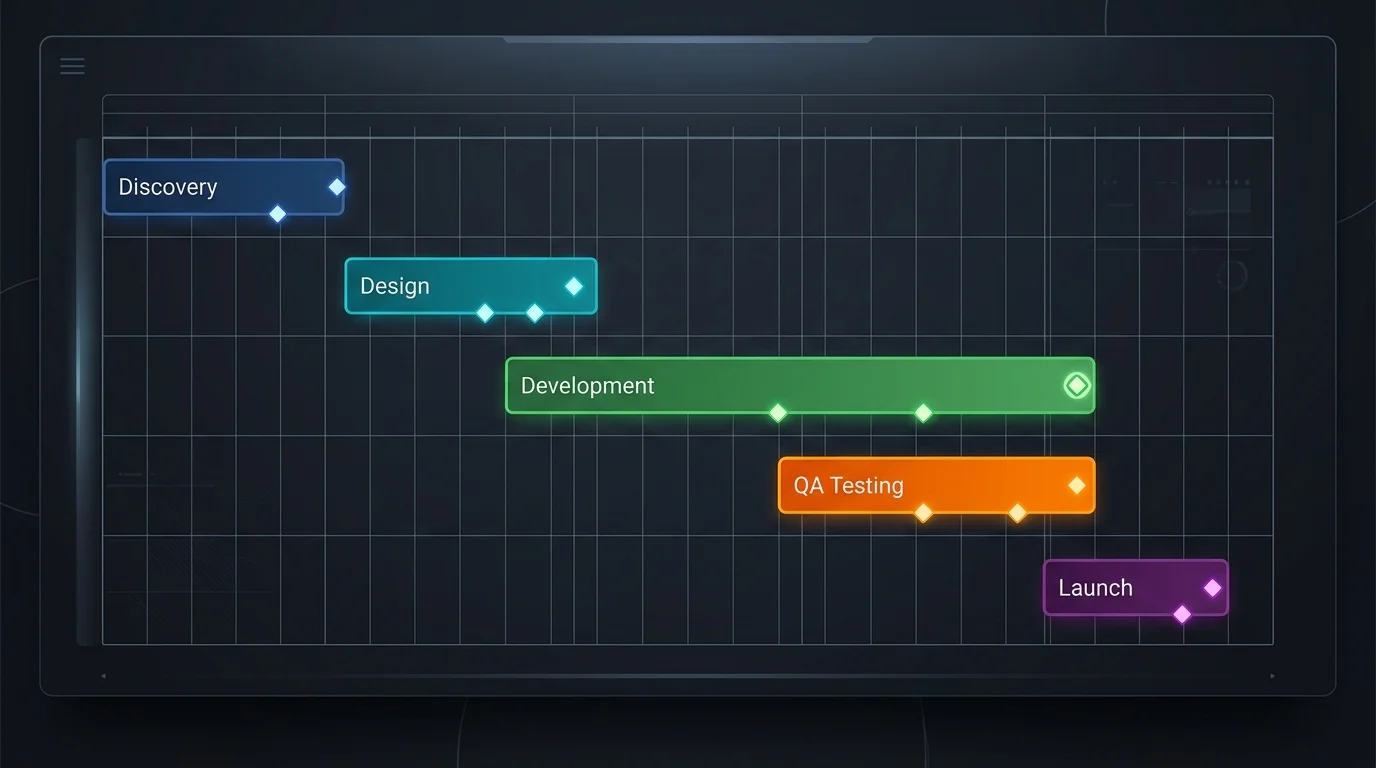
Realistic timelines for Bubble migrations range from two to six weeks for simple-to-mid-complexity apps and eight to twelve weeks for complex ones. Any agency quoting two weeks for a non-trivial app is either underestimating or planning to cut corners. Ask for a week-by-week breakdown: audit, architecture, core rebuild, QA, and cutover should each have dedicated time.
Question 6: "What is your QA process?"
Quality assurance should be 15 to 25 percent of the project budget. A good agency has dedicated QA specialists, automated testing for critical paths, integration testing for payment and email flows, and a documented rollback plan. An agency that says "we test as we go" will ship bugs that cost two to three times more to fix after launch than before.
Question 7: "Why are you recommending this tech stack?"
The answer should reference your specific app — not their default preference. "We recommend Next.js because your app is frontend-heavy with SEO requirements" is a good answer. "It is what we use" is a red flag. If the agency cannot explain how different frameworks map to different app profiles, they lack the technical depth to make this decision for you.
Question 8: "What happens after launch?"
The first 30 to 90 days after launch are critical. Bugs surface when real users hit edge cases that testing missed. A quality agency offers a warranty period (30 to 90 days) covering bug fixes at no additional charge, plus a clear SLA for response times: critical issues within 24 hours, major issues within three business days. An agency that says "we are done when we launch" is an agency you will never want to work with again.
Question 9: "Who owns the code and data?"
The only acceptable answer: "You own 100 percent of the custom code and all data, with zero export fees." Any clause where the agency "retains reuse rights" means they can sell your architecture to competitors. Any per-gigabyte export fee is a lock-in mechanism. Get IP assignment in writing before signing.
Question 10: "Can you provide a detailed scope of work before I commit?"
A scope of work is not a proposal — it is a contract-ready document listing every feature, every integration, every data model, with acceptance criteria for each. It defines what is in scope, what is explicitly out of scope, and the process for handling change orders. An agency that resists writing a detailed SOW is an agency planning to bill you for ambiguity.
- 8-10 strong answers: Move to contract negotiation
- 6-7 strong answers: Acceptable, but negotiate on weak areas
- Below 6: Keep looking — the risk is too high
Red Flags That Should Kill the Deal
Some warning signs are disqualifying on their own. If you encounter any of these during the vetting process, walk away — regardless of how impressive the portfolio looks.
Pricing Red Flags
| Pattern | What It Signals | Your Risk |
|---|---|---|
| Quote 50%+ below competitors | Cutting discovery, QA, or both | Change orders will close the gap — and then some |
| 50%+ payment upfront | Cash flow problems or no confidence in delivery | No leverage if quality drops |
| No change order process defined | Scope will expand without cost controls | Budget overruns with no accountability |
| Vague "per phase" pricing | No commitment to specific deliverables | Paying for time, not outcomes |
Process Red Flags
- "We can start building immediately" — No discovery means no understanding of what they are building
- "We will figure it out as we go" — Translation: your budget is their learning curve
- Slow pre-contract communication — If they are slow during sales (when most motivated), expect worse after signing
- Cannot explain technical decisions — Vague answers about architecture signal shallow expertise
- Portfolio has no live URLs — Cannot verify the work actually exists or performs well
- No post-launch support plan — They are optimizing for project close, not your success
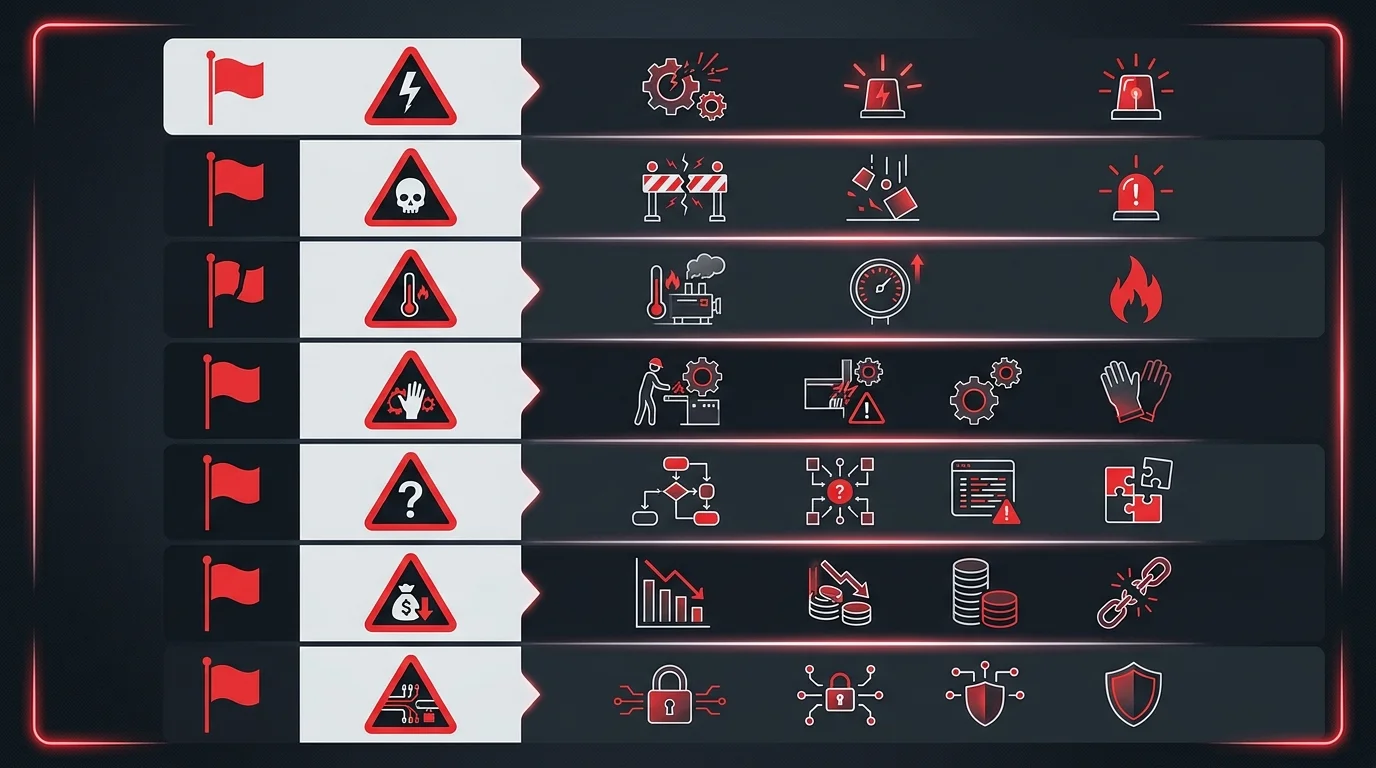
Any agency promising to migrate a non-trivial Bubble app in two weeks is either planning to skip discovery and QA, or does not understand the scope. Realistic timelines: simple apps take two to four weeks, mid-complexity takes four to eight weeks, and complex apps take eight to twelve weeks. Urgency before contract signing is a pressure tactic, not a schedule.
Green Flags That Signal a Quality Partner
The best agencies share specific patterns that predict project success. Look for these signals during your evaluation.
Structured Discovery Process
A quality agency treats discovery as a standalone engagement — one to two weeks, with documented deliverables you can take to another vendor if you choose. Their discovery produces a requirements document, a data audit, an architecture recommendation, and a risk assessment. This is typically 10 to 15 percent of the total project budget and is the highest-ROI investment in the entire migration.
Iterative Migration Approach
The best agencies do not propose a "big bang" cutover where everything switches at once. They migrate piece by piece — reporting dashboard first, then authentication, then core workflows — validating each piece before moving to the next. This reduces risk dramatically because problems surface early when they are cheap to fix.
Honest Scope Assessment
A green flag that surprises most founders: the agency that tells you not to migrate everything. Some Bubble features — simple forms, admin dashboards, basic CRUD operations — work fine where they are. A hybrid approach where Bubble handles the UI layer while custom code handles performance-critical operations can cut migration cost by 40 to 60 percent. An agency that recommends this when appropriate is optimizing for your outcome, not their invoice.
| Green Flag | What It Indicates |
|---|---|
| Asks detailed questions before quoting | Values accuracy over speed-to-close |
| Provides references you can actually call | Confident in past client satisfaction |
| Explains what could go wrong | Experienced enough to anticipate risks |
| Recommends against unnecessary migration | Prioritizes your ROI over their revenue |
| Offers standalone discovery engagement | No lock-in — earn the build phase on merit |
| Names specific team members for your project | Accountability and continuity ensured |
Agency vs Freelancer vs In-House: The Real Tradeoffs
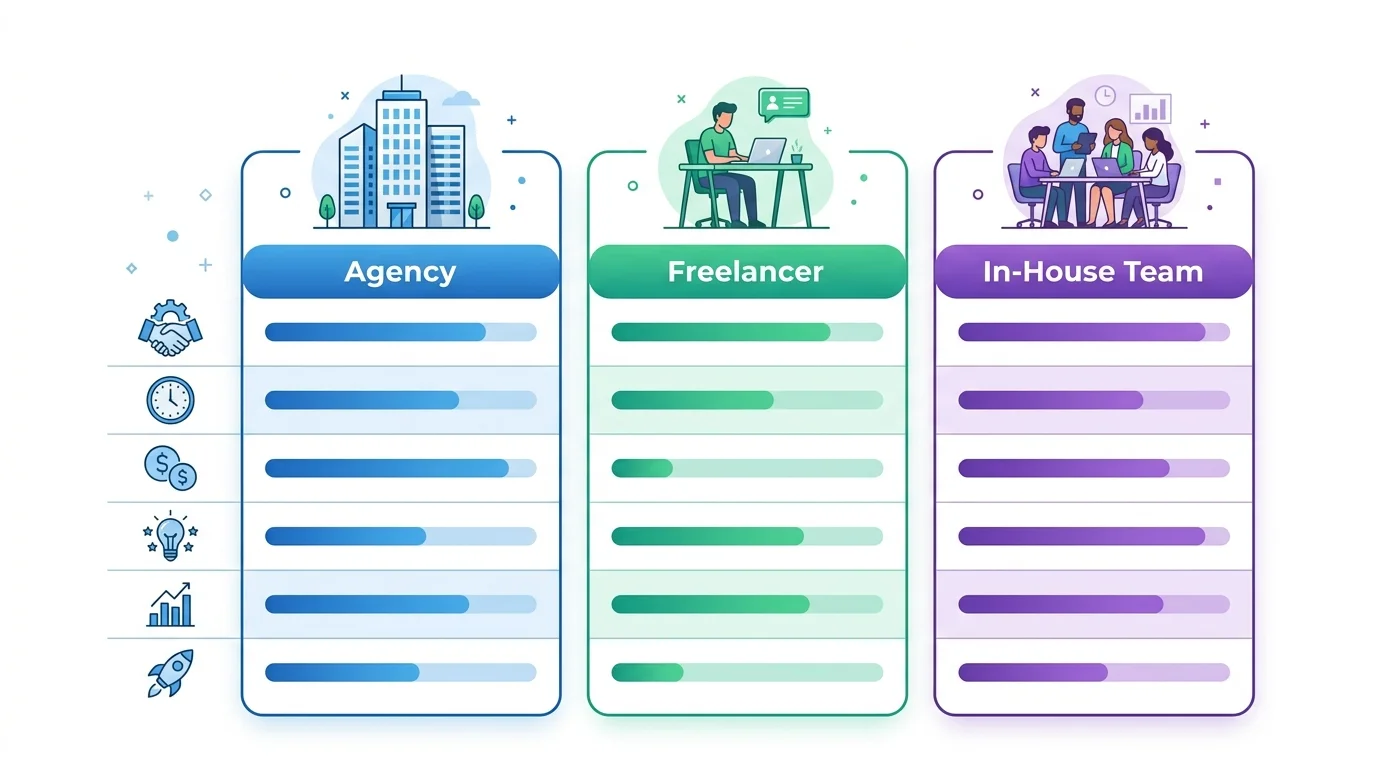
Before vetting agencies, confirm that an agency is the right model for your migration. Each approach has distinct cost, risk, and timeline profiles.
| Factor | Agency | Freelancer | In-House Team |
|---|---|---|---|
| Typical Cost | $18K–$80K+ | $5K–$25K | $150K–$250K/year |
| Timeline | 3–6 months | 4–8 months | 6–12 months |
| Quality Control | Structured QA process | Variable, often absent | Your responsibility |
| Post-Launch Support | SLA-backed warranty | Unreliable | Built-in (your team) |
| Risk Profile | Low-Medium | High | Medium |
| Best For | Complex apps, fixed deadlines | Simple apps, tight budgets | Long-term product companies |
The Hidden Cost of Cheap Freelancers
Freelancers on platforms like Upwork typically quote substantially less than agencies — often a fraction of agency rates. However, retrospectives commonly report that freelancer-built migrations end up costing more long-term due to technical debt, missing documentation, and rework. A cheap freelancer build that later requires an agency rescue can easily cost more in total than hiring the agency from the start.
- Simple app (5 pages, basic CRUD) → Freelancer is fine if you can manage QA yourself
- Mid-complexity (15+ pages, workflows, APIs) → Agency recommended for structured delivery
- Complex (30+ pages, heavy backend logic) → Agency required or in-house team with migration experience
- Mission-critical (payments, compliance, high traffic) → Agency with verifiable migration portfolio only
How to Structure the Contract
The contract is where vetting translates into protection. Even a great agency relationship needs clear terms to prevent scope disputes, payment conflicts, and ownership ambiguity.
Payment Structure (Milestone-Based)
Tie every payment to a verifiable deliverable. Never pay more than 25 percent upfront.
| Milestone | Payment | Trigger |
|---|---|---|
| Contract signing | 20% | Signed SOW with detailed deliverables |
| Discovery complete | 15% | Requirements doc + data audit + architecture plan approved |
| Design approved | 15% | Database schema + API specs + wireframes signed off |
| Feature-complete | 30% | All features pass acceptance criteria testing |
| Launch + 30-day warranty | 20% | Successful launch, zero critical bugs for 30 days |
Five Clauses You Must Have
- IP ownership: You own 100 percent of custom code, designs, and documentation upon final payment. The agency retains rights only to pre-existing libraries and open-source components.
- Change order process: Any scope change requires a written change order with cost and timeline impact before work begins. No verbal agreements.
- Warranty period: 30 to 90 days post-launch. Critical bugs fixed within 24 hours. Major bugs within five business days. At no additional charge.
- Termination clause: Either party can terminate with 30 days written notice. You receive all code, documentation, and work-in-progress upon termination.
- Data portability: You own your data. Zero export fees. Agency provides full database export within five business days of request.
The Architecture Documentation Advantage
Agencies estimate poorly when they cannot see what they are building. A complete architecture blueprint — data schemas, API specifications, backend workflows, privacy rules — meaningfully tightens the spread between agency quotes for the same app. It also eliminates the most expensive category of change orders: the ones caused by discovering undocumented logic mid-build. Founders who arrive at agency conversations with structured architecture documentation typically receive both lower quotes and tighter ranges than those who do not, because the agency is no longer pricing in the cost of discovering scope on the fly. (Refer to proper architecture docs for what to bring to that conversation.)
Frequently Asked Questions (FAQ)
Q. How many agencies should I evaluate?
Three to five is the sweet spot. Fewer than three gives you no comparison basis. More than five creates evaluation fatigue and slows the decision. Request proposals from five, shortlist three for detailed conversations, and choose one.
Q. Should I pay for a discovery phase before committing to the full build?
Yes — and the best agencies offer this. A standalone discovery engagement (typically 10 to 15 percent of total project cost) gives you documented deliverables you own. If the agency relationship does not work out, you take those documents to another vendor with zero wasted work.
Q. What if the cheapest quote is from the most experienced agency?
Verify scope alignment. Ask each agency to itemize what is included. The cheapest quote is only a red flag when it excludes discovery, QA, or post-launch support. If the experienced agency simply has lower overhead or offshore team rates, it can be legitimate.
Q. Can I use AI tools to reduce agency costs?
Yes. AI-assisted migration workflows can accelerate development by two to three times when fed structured architecture blueprints. Some agencies already use AI coding tools, which should be reflected in lower quotes. Ask: "Do you use AI coding assistants, and how does that affect your timeline and pricing?"
Q. What happens if the agency goes out of business mid-project?
This is why milestone-based payments and IP ownership clauses matter. If you own the code and have documentation at each milestone, you can hand the project to another team. For projects over $100K, consider a source code escrow agreement ($1,500 to $5,000 setup) that automatically releases code to you if the vendor ceases operations.
Q. How do I evaluate agencies if I am non-technical?
Focus on process, not technology. The 10-question checklist above works regardless of your technical knowledge. Additionally: ask for references and actually call them. Ask those references the three questions that matter most: "Did it stay on timeline?", "Did it stay on budget?", "Would you hire them again?"
Hire Slow, Migrate Fast
- Ask all 10 questions: Every question reveals a dimension of the agency's process. Six strong answers is the minimum threshold.
- Watch for red flags first: A single disqualifying red flag outweighs a dozen green flags. Walk away early.
- Invest in discovery: A paid, standalone discovery phase is the single highest-ROI spend in the entire migration. It reduces quote variance, prevents scope creep, and produces documentation you own.
- Structure payments around milestones: Never pay more than 25 percent upfront. Tie every payment to a verifiable deliverable.
- Document your architecture before soliciting quotes: Complete blueprints meaningfully tighten quote variance and eliminate the most expensive category of change orders.
The hour you spend vetting agencies will save you months of rework and tens of thousands in change orders. Hire slow. Then migrate fast — with a partner you trust.
Get Your Architecture Blueprint Before You Talk to Agencies
Relis extracts your complete Bubble architecture — data schemas, API specs, backend workflows, privacy rules — so agencies can quote accurately and build confidently.
Extract Your Blueprint →Ready to Plan Your Migration?
Get a complete architecture blueprint — ERD, DDL, API docs, workflow specs — everything your developers need to start rebuilding.
Ready to Plan Your Migration?
Get a complete architecture blueprint — ERD, DDL, API docs, workflow specs — everything your developers need to start rebuilding.