Building Your Post-Bubble Engineering Team: Hiring, Onboarding, and the No-Code to Code Culture Shift
After migrating from Bubble, your team needs developers who can maintain and extend a custom codebase. This guide covers when to hire, what roles to fill first, how to evaluate candidates without being technical yourself, onboarding practices, and managing the culture shift from no-code speed to engineering discipline.
17 min read
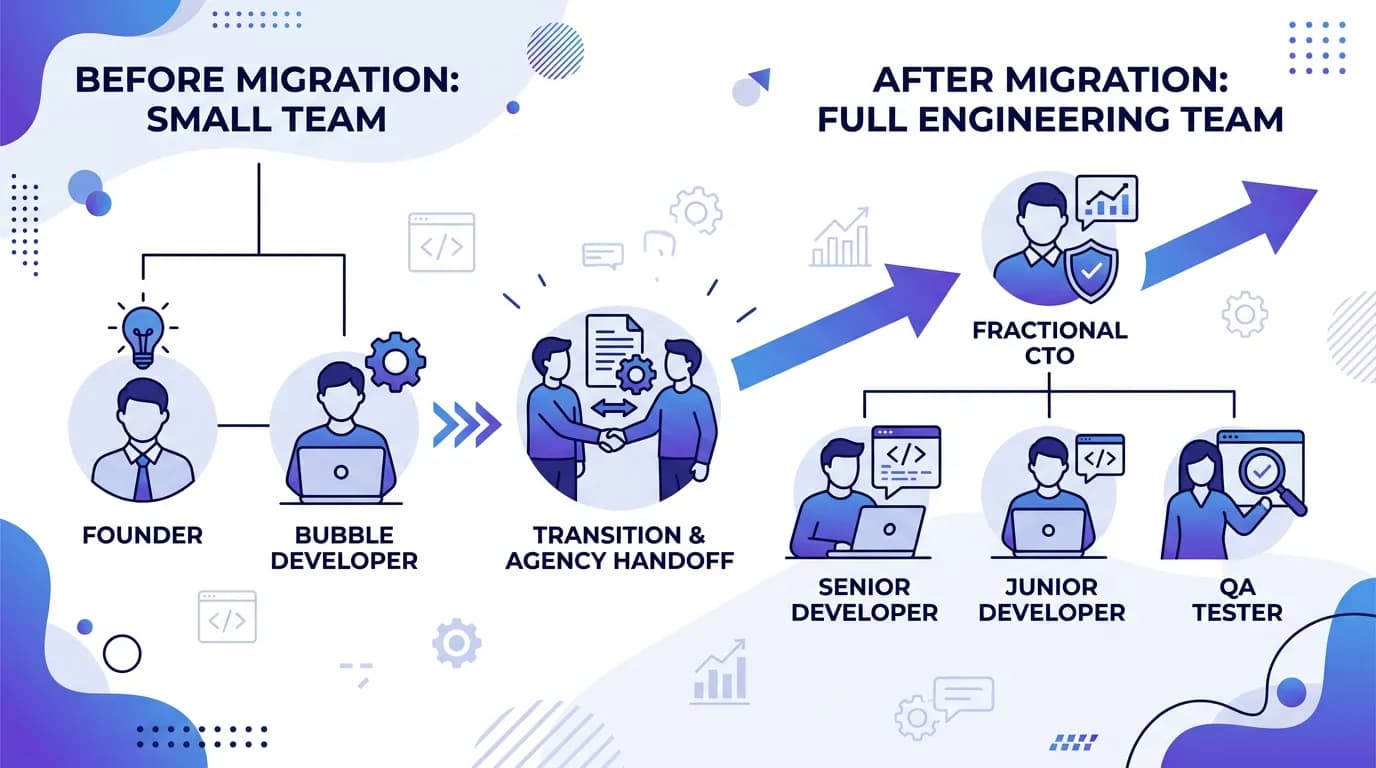
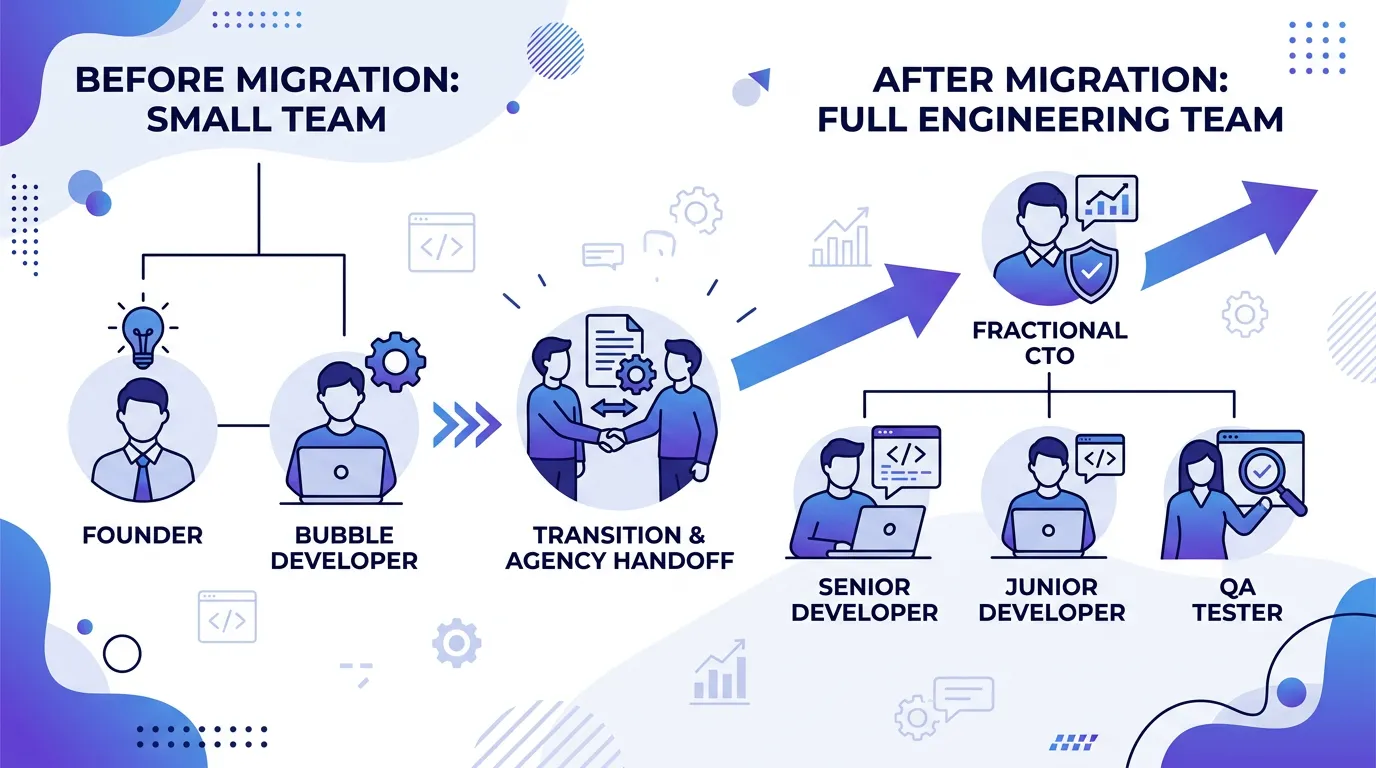
On Bubble, your product team might have been you, a Bubble developer, and a designer. Features shipped in hours. No standups, no code reviews, no sprint planning. After migration, you have a React codebase, a PostgreSQL database, a deployment pipeline, and a backlog of features that need developers to build. The team structure that worked on Bubble does not work on custom code — not because the people are wrong, but because the work is fundamentally different.
This guide covers the practical reality of building your first engineering team after migration: who to hire first, how to evaluate candidates when you are not technical, how to onboard developers to an inherited codebase, and how to manage the cultural transition from no-code's rapid iteration to engineering's deliberate process.
The Team You Need (and When You Need Them)
Not every post-Bubble company needs a 10-person engineering team. The right team size depends on your product complexity, growth rate, and whether you outsource infrastructure management.
| Stage | Revenue | Recommended Team | Monthly Cost |
|---|---|---|---|
| Post-migration startup | Under $50K MRR | 1 full-stack dev + fractional CTO | $8K–$15K |
| Growing SaaS | $50K–$200K MRR | 2–3 developers + tech lead | $25K–$50K |
| Scaling company | $200K+ MRR | 4–8 developers + CTO + QA | $60K–$120K |
The Timing Question
Hire before migration completes if possible — your first developer should participate in the final migration phases (testing, launch, stabilization). They gain deep knowledge of the codebase that no documentation can replace. If you hired an agency for migration, your first developer should overlap with the agency for 2 to 4 weeks of knowledge transfer.
The First Three Hires
Hire 1: Full-Stack Developer (Senior)
Your first developer must be senior (5+ years experience) and full-stack (comfortable with both React/Next.js frontend and Node.js/PostgreSQL backend). They will be the sole maintainer of the codebase for the first 3 to 6 months — they need the confidence and experience to work independently, make architectural decisions, and debug production issues at 2 AM.
Must have: Experience with your tech stack (Next.js + PostgreSQL or equivalent), production deployment experience, and comfort working with inherited codebases (they are joining someone else's code, not greenfield).
Hire 2: Fractional CTO (Part-Time)
If you are a non-technical founder, a fractional CTO (10 to 15 hours per week) provides strategic technical leadership without full-time cost: reviewing code quality, guiding architecture decisions, mentoring your first developer, and translating business priorities into technical roadmaps. A fractional CTO costs $3K to $8K per month — 20 to 30 percent of a full-time CTO salary.
Hire 3: Second Developer (Mid-Level)
Once your first developer is established and the codebase is stable, add a mid-level developer (2 to 4 years experience) to increase velocity. The senior developer mentors them, reviews their code, and delegates defined tasks. This mentorship model scales better than hiring two mid-level developers who have no one to learn from.
If you have a Bubble developer on your team, they bring invaluable product knowledge — they know what the app does and why. Some Bubble developers transition to custom code by learning React/Node.js (6 to 12 months of focused learning). Others transition to product management or QA roles where their product knowledge adds direct value. Either path is more valuable than letting them go — product knowledge is harder to replace than technical skills.
Evaluating Developers Without Being Technical
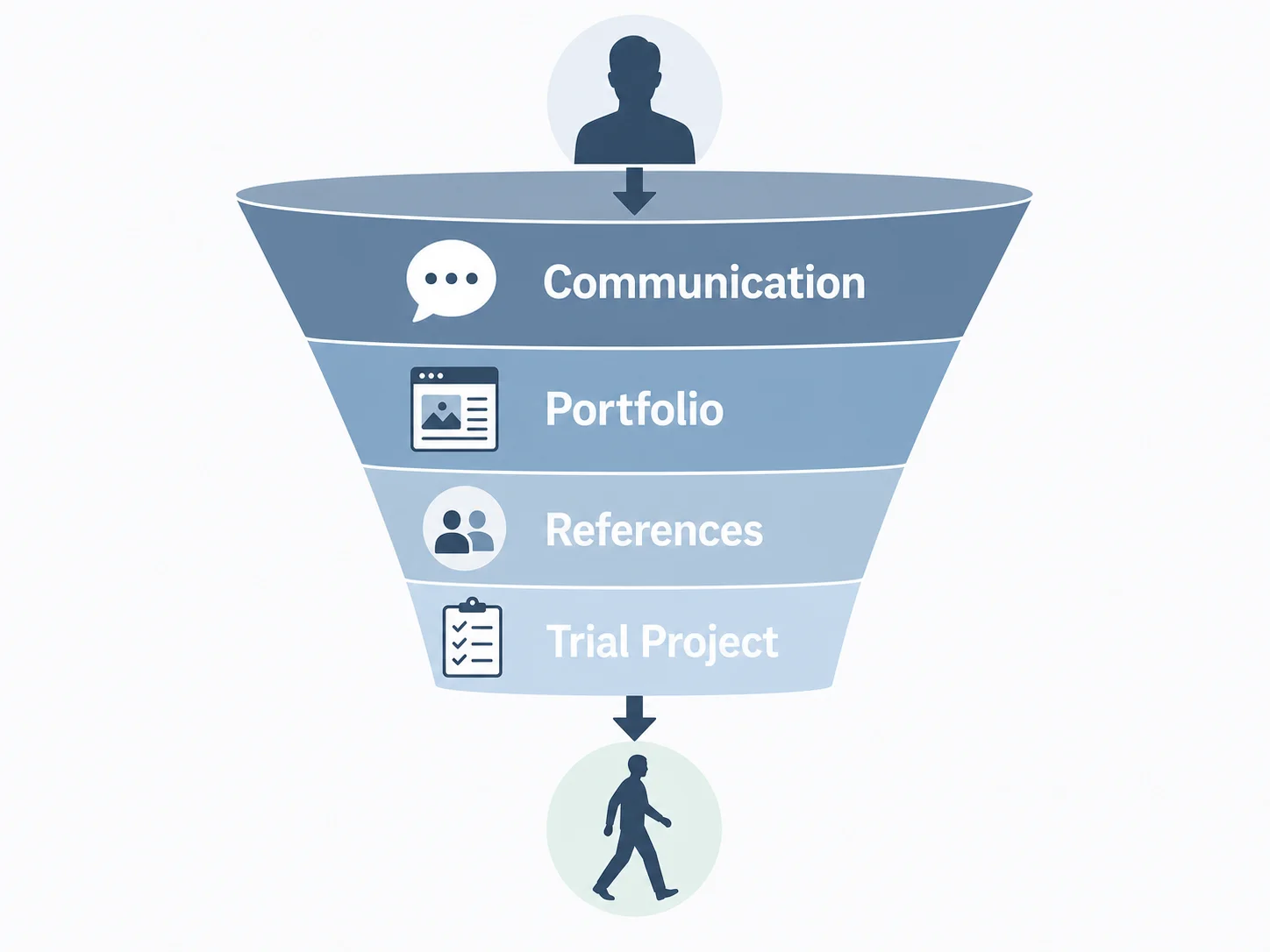
You cannot review code. But you can evaluate competence through signals that do not require technical knowledge.
Signal 1: Communication Quality
Ask candidates to explain a complex technical concept to a non-technical person. The best developers explain clearly without condescension. If a candidate cannot explain their work in terms you understand, they will not be able to communicate effectively about features, tradeoffs, or blockers — and communication failures cause more project problems than technical skill gaps.
Signal 2: Portfolio and Production Experience
Ask to see applications they have built and deployed to production. Running code > GitHub repositories > tutorial projects. Ask: "What went wrong after launch, and how did you fix it?" Production experience reveals debugging skill, resilience, and ownership — qualities that tutorials and bootcamps do not test.
Signal 3: Technical Assessment (Delegated)
Have your fractional CTO or a trusted technical advisor conduct a technical interview. They evaluate: code quality (does the candidate write clean, readable code?), system design (can they architect solutions, not just implement them?), and problem-solving approach (do they ask clarifying questions or dive in blindly?). Your job is to evaluate the technical advisor's assessment — not to evaluate the code yourself.
Signal 4: Trial Project
Offer a paid trial project (40 hours, $2K to $4K) before making a full-time offer. Assign a real task from your backlog — a feature, a bug fix, or a performance improvement. Evaluate: did they deliver on time? Did they communicate proactively? Did they ask good questions? Was the result actually working? A trial reveals more in one week than any interview reveals in one hour.
| Signal | What You Evaluate | Red Flag |
|---|---|---|
| Communication | Can they explain technical decisions clearly? | Uses jargon to impress rather than to inform |
| Portfolio | Have they shipped real products? | Only personal projects, no production experience |
| References | What do previous employers say? | No references available or vague praise only |
| Trial project | Can they deliver on your actual codebase? | Missed deadline without communicating early |
| Problem-solving | Do they ask questions before building? | Builds first, asks never — delivers wrong thing |
Onboarding Developers to a Post-Migration Codebase
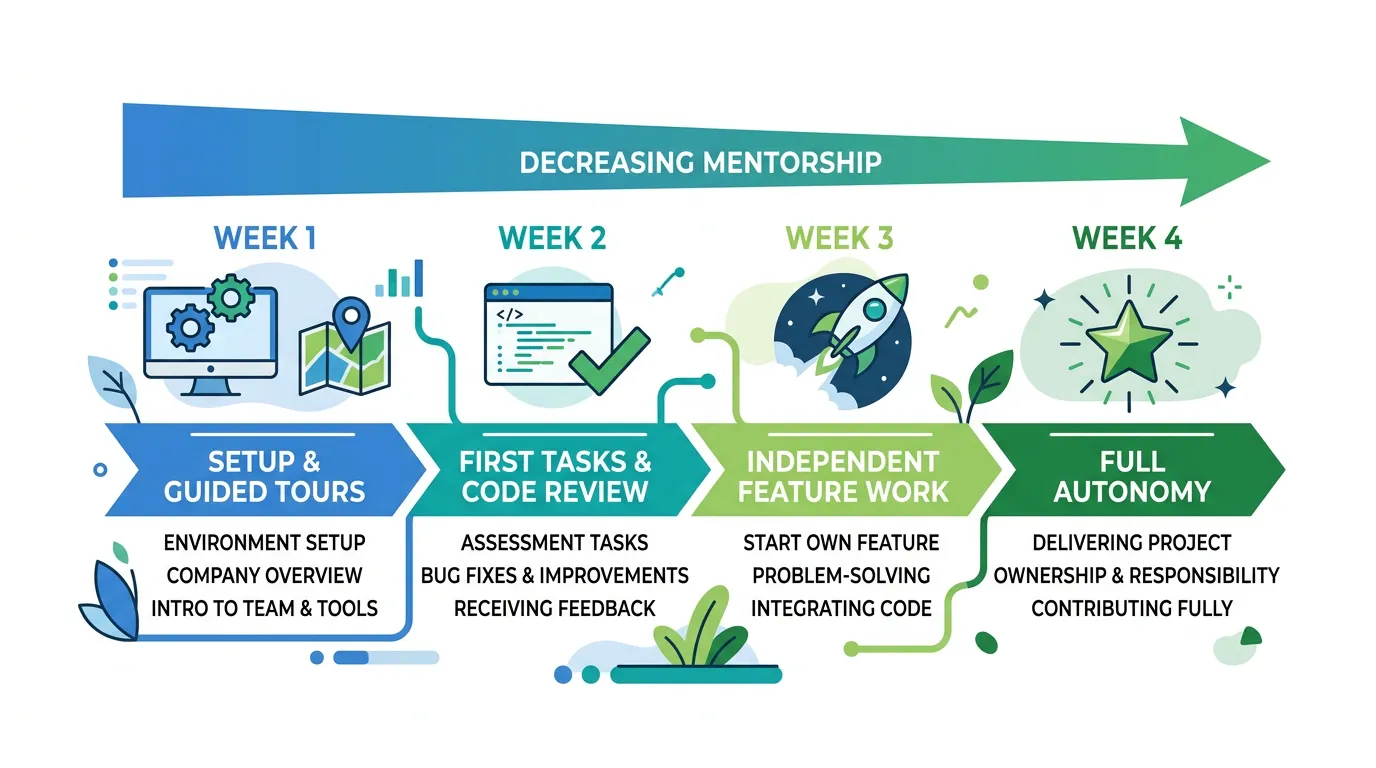
Your codebase is inherited — your new developer did not write it. Effective onboarding bridges the gap between "I can read this code" and "I understand why it was built this way."
The Onboarding Document
Create a document that covers: project setup instructions (clone, install, run locally in under 30 minutes), architecture overview (which folders contain what, how data flows from frontend to backend to database), key decisions and their rationale (why Supabase instead of Firebase, why BullMQ instead of Inngest), environment setup (environment variables, API keys for development), and deployment process (how to deploy to staging and production).
The Guided Tour
Walk the new developer through three complete user flows: a signup/login flow (touches auth, database, email), a core feature flow (touches frontend, API, database, possibly background jobs), and an admin flow (touches authorization, data aggregation, reporting). These three flows expose 80 percent of the codebase architecture. The developer asks questions along the way — and the answers become additions to the onboarding document.
The First Task
Assign a well-scoped first task on day 3 or 4 — not a critical feature, but a real task that touches multiple layers (frontend change + API change + database query). This forces the developer to navigate the codebase, understand the development workflow (branch, commit, PR, deploy), and deliver something tangible. A good first task: "Add a new column to the users table in the admin dashboard." It is small enough to finish in a day, but it touches frontend (table component), API (data fetching), and database (query).
The Culture Shift: No-Code Speed to Engineering Discipline
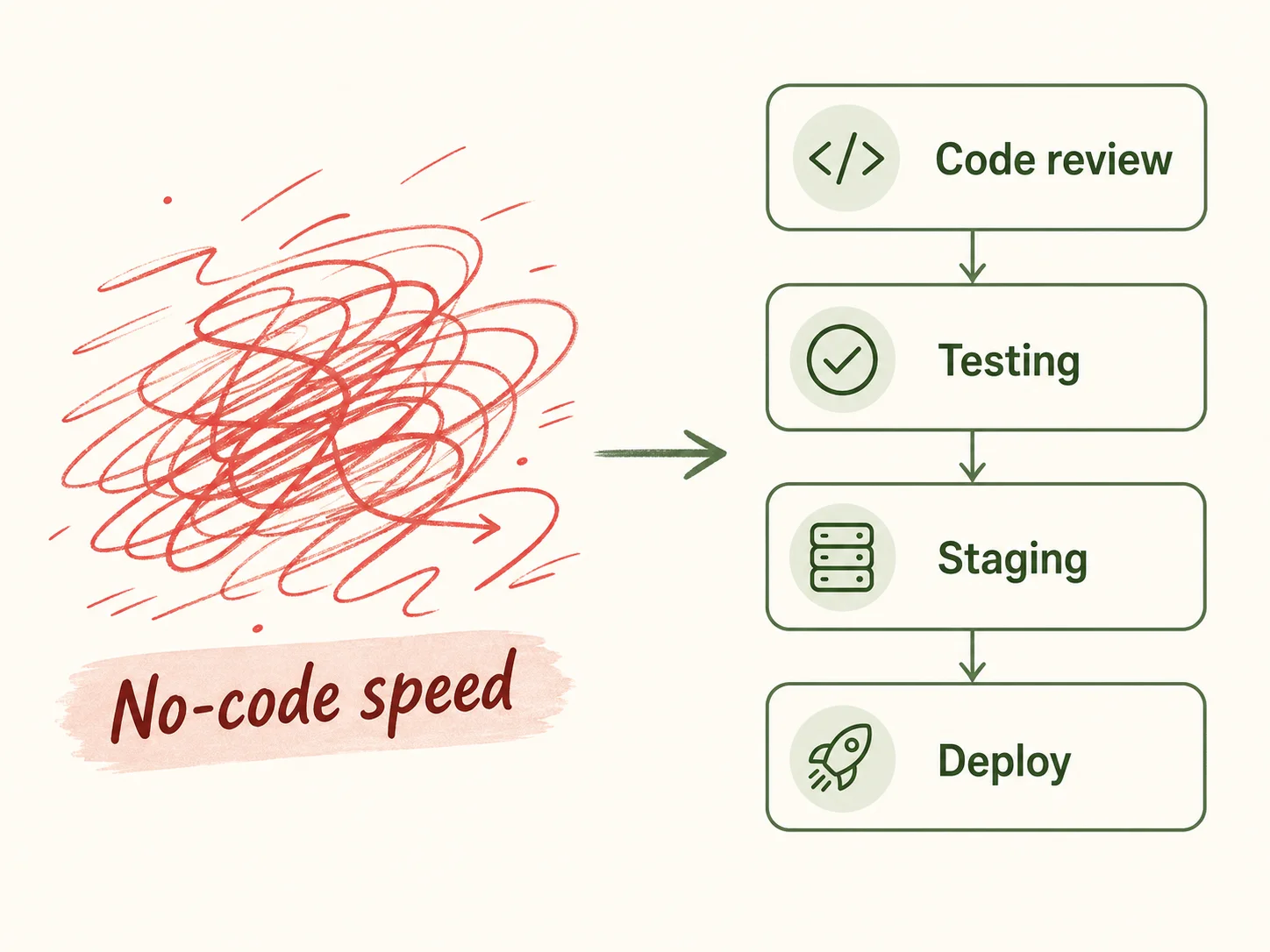
This is the hardest part of the transition — and it is not technical. On Bubble, you shipped features in hours. On custom code, the same feature takes days. This is not because custom code is worse — it is because custom code includes steps that Bubble skipped: code review, testing, staging validation, and deliberate deployment.
What Slows Down (and Why It Is Good)
Code review adds 4 to 24 hours to every feature. But it catches bugs, spreads knowledge across the team, and prevents a single developer from being the only person who understands a feature. Testing adds 20 to 50 percent to development time. But it prevents regressions — the feature you shipped last week still works after this week's changes. Staging validation adds 1 to 2 days before production. But it catches the edge cases that parity testing revealed are abundant in real-world usage.
What Speeds Up
Some things are genuinely faster on custom code: complex business logic (code is more expressive than visual workflows for complex conditions), performance optimization (you control every query, every cache, every index), debugging (stack traces, logging, and debugging tools are more powerful than Bubble's debugger), and scaling (add resources, not workarounds).
Setting Expectations
Communicate to your team and stakeholders: "We will ship fewer features per week, but each feature will be more reliable, more performant, and easier to maintain. The velocity we lost in speed, we gained in quality." This reframing prevents the "Bubble was faster" conversation that demoralizes engineering teams and undermines the migration's value.
The temptation is to skip code review, skip testing, and deploy directly to production — recreating Bubble's speed in custom code. This works for a week. Then a bug reaches production, corrupts data, and takes 3 days to fix. Engineering discipline exists because software at scale requires it. The migration was about gaining control — that control requires process.
Fractional, Full-Time, and Agency: The Hiring Mix
| Option | Best For | Cost | Commitment |
|---|---|---|---|
| Full-time developer | Core product development, ongoing maintenance | $6K–$15K/mo (depending on location) | Long-term |
| Fractional CTO | Technical leadership without full-time cost | $3K–$8K/mo (10–15 hrs/week) | 6–12 months, then re-evaluate |
| Agency retainer | Overflow work, specialized features | $5K–$15K/mo | Monthly, flexible |
| Freelance developer | Specific projects, short-term needs | $50–$150/hr | Project-based |
| Offshore team | Cost-sensitive development at scale | $3K–$8K/mo per developer | 6+ months for quality |
The Recommended Mix by Stage
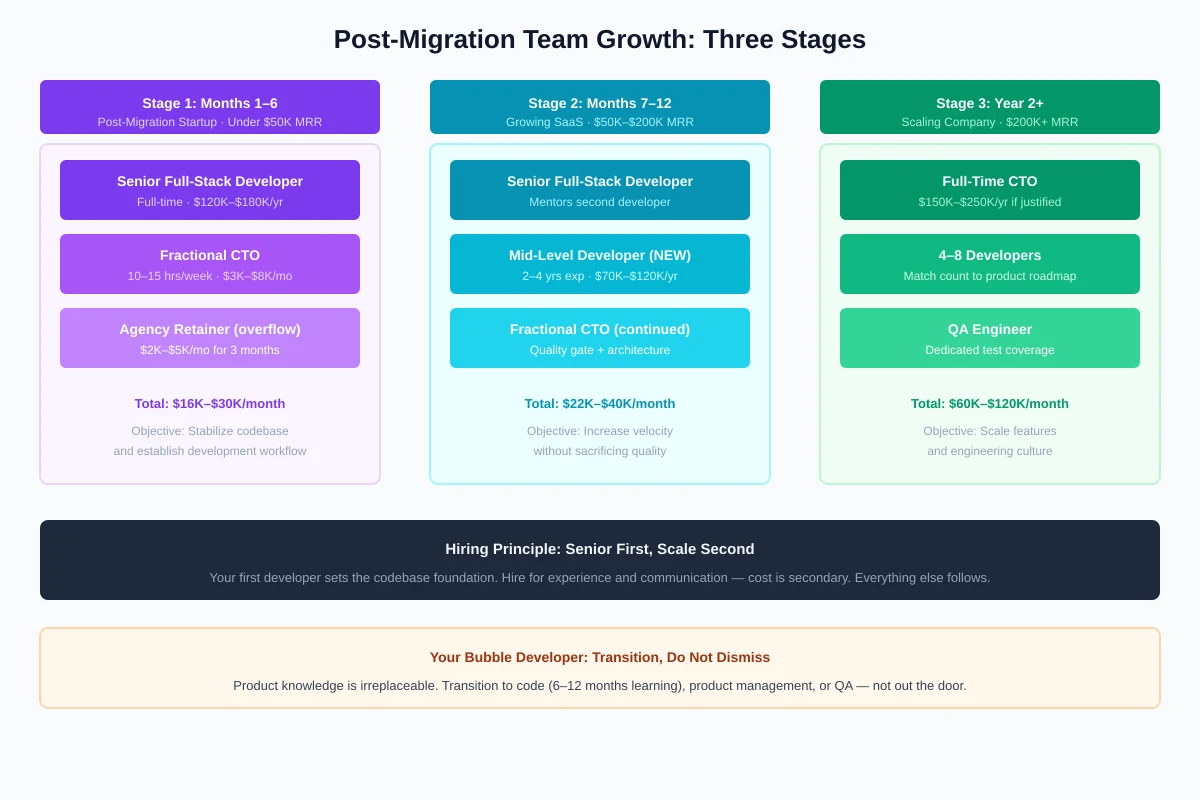
Months 1 to 6 (post-migration): 1 full-time senior developer + fractional CTO + agency on retainer for overflow. Total: $16K to $30K/month. This provides daily development capacity, strategic technical leadership, and surge capacity for urgent features.
Months 7 to 12: Add a second developer, reduce agency retainer, keep fractional CTO. Total: $22K to $40K/month. The second developer increases velocity while the fractional CTO ensures quality.
Year 2+: Evaluate full-time CTO hire (if revenue justifies $150K to $250K salary), add developers to match product roadmap, and phase out fractional/agency support as internal capability grows.
If an agency built your migration, keep them on a small retainer ($2K to $5K/month) for 3 months post-launch. They have deep context on the codebase they built, and their availability for emergency debugging during the stabilization phase is invaluable. Phase them out as your internal team builds context.
Frequently Asked Questions
Q. Can my Bubble developer learn custom code?
Some can, with time and support. Bubble development teaches logic, data modeling, and product thinking — valuable foundations. The gap is syntax, tooling, and engineering practices (Git, testing, code review). Budget 6 to 12 months of learning alongside a senior developer mentor. Not every Bubble developer will make this transition — it requires genuine interest in code, not just willingness.
Q. Should I hire locally or remotely?
Remote. The talent pool for your specific stack (Next.js + PostgreSQL) is global, and remote developers are typically 30 to 50 percent less expensive than local hires in high-cost markets. For post-Bubble teams that already collaborate remotely (most do), adding remote developers is a natural extension. Require 4+ hours of timezone overlap for synchronous collaboration.
Q. What salary should I expect to pay for my first developer?
Varies by location and seniority. These are rough market estimates that vary by year, source, and seniority — verify against levels.fyi / Stack Overflow Developer Survey before committing to a number. US-based senior full-stack: $120K to $180K/year. EU-based: $80K to $130K/year. Latin America: $50K to $90K/year. Eastern Europe: $40K to $80K/year. South/Southeast Asia: $30K to $60K/year. These are full-time annual rates. Prioritize experience and communication skills over cost — your first developer sets the foundation for everything that follows.
Q. When should I hire a full-time CTO instead of fractional?
When your engineering team reaches 4 to 5 developers and technical decisions become daily rather than weekly. A fractional CTO (10 to 15 hours/week) works for 1 to 3 developers. Beyond that, the coordination, planning, and people management requires full-time attention. Also consider full-time CTO when raising Series A or beyond — investors expect dedicated technical leadership at that stage.
Q. How do I prevent key-person dependency on my first developer?
Three practices: (1) code review on every PR (ensures at least two people understand every change), (2) architecture documentation updated monthly (reduces tribal knowledge), and (3) hire the second developer within 6 months (no developer should be the sole maintainer for more than 6 months). If your first developer leaves and nobody else understands the codebase, you have a new kind of lock-in — and this one has no exit tool.
Q. Should I learn to code myself as a founder?
Learn to read code, not write it. Understanding what a pull request changes (the diff), what a test verifies, and what an error message means takes 20 to 40 hours of focused learning — and it transforms your ability to evaluate engineering work. You do not need to write React components. You do need to know if a PR is adding a feature or a hack.
Build the Team That Matches Your Stage
- Start with one senior developer and a fractional CTO: Your first hire should be senior enough to work independently and experienced enough to maintain an inherited codebase. A fractional CTO provides strategic guidance at 20 to 30 percent of full-time cost.
- Evaluate with signals, not technical tests: Communication quality, production experience, references, and paid trial projects tell you more than technical interviews when you are not technical yourself. Delegate technical evaluation to your fractional CTO or a trusted advisor.
- Onboard to the codebase, not just the tools: A guided tour of three user flows exposes 80 percent of the architecture. A well-scoped first task on day 3 builds confidence and reveals the development workflow. Update the onboarding document with every new developer's questions.
- Manage the speed expectation: Custom code is slower to ship but more reliable, performant, and maintainable. Reframe the conversation: "We traded speed for quality and control — exactly why we migrated."
- Scale the team with revenue: As a rough heuristic, one developer at $50K MRR, 3 developers at $200K MRR, CTO at $500K+ MRR. Match headcount to revenue, not ambition. Overhiring before product-market fit is the most expensive mistake a post-Bubble startup can make.
The team that maintains your product matters as much as the technology it runs on. Hire carefully, onboard thoroughly, and build a culture that values both speed and quality — the combination that made you leave Bubble and the combination that makes custom code worth the investment.
Give Your New Team the Architecture Blueprint
Relis extracts your complete Bubble architecture — the specification your new developers need to understand what they inherited and what needs building next. Better onboarding starts with better documentation.
Scan My App — FreeReady to Plan Your Migration?
Get a complete architecture blueprint — ERD, DDL, API docs, workflow specs — everything your developers need to start rebuilding.
Ready to Plan Your Migration?
Get a complete architecture blueprint — ERD, DDL, API docs, workflow specs — everything your developers need to start rebuilding.