Gradual Migration from Bubble: The Strangler Fig Approach
A full migration is not your only timeline option. The strangler fig pattern lets you replace Bubble components one at a time — backend first, then frontend, then data — while keeping the app running continuously. This guide covers the phased migration strategy, proxy routing, shared authentication, and the decision framework for what to migrate first.
13 min read
The standard Bubble migration approach is "big bang" — rebuild the entire app in parallel, then switch everything at once on cutover weekend. This works for simple apps, but for complex applications with 20+ data types, multiple integrations, and thousands of active users, the big bang carries enormous risk. One missed workflow, one broken integration, one data migration error, and your cutover weekend becomes a rollback emergency.
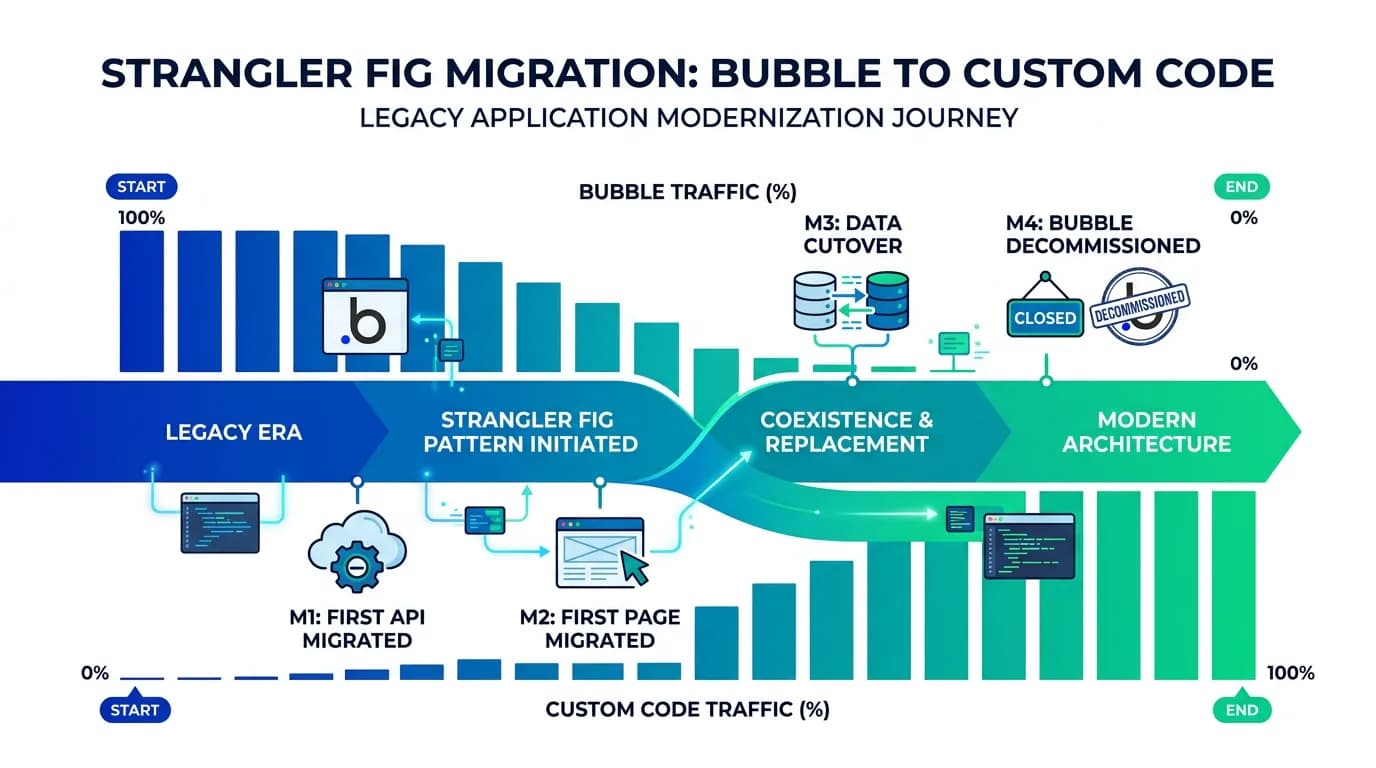
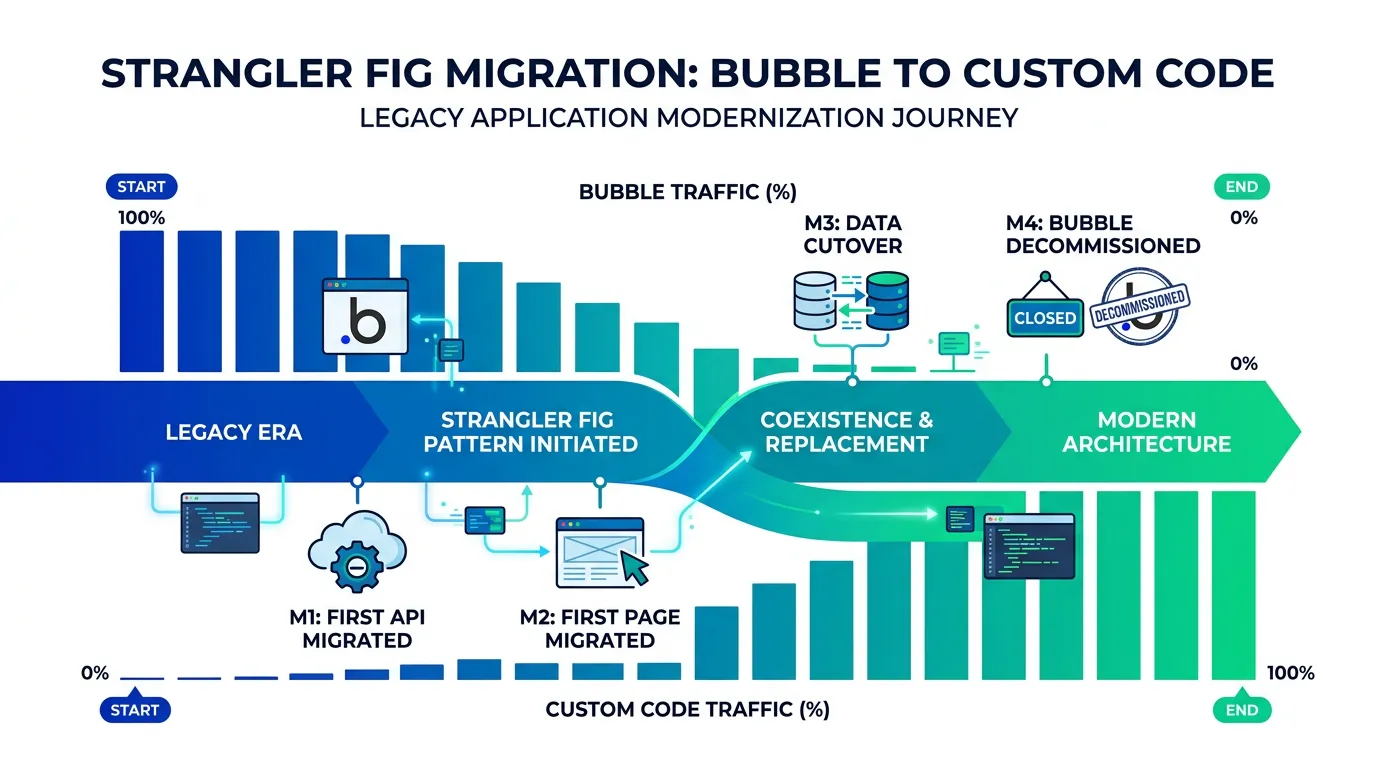
The strangler fig pattern — named after the tropical fig that gradually grows around and replaces its host tree — offers an alternative. Instead of rebuilding everything and switching at once, you replace components one at a time. The backend API moves first. Then individual frontend pages. Then the data layer. At each step, the app continues running. Users never experience downtime. And if something goes wrong, you roll back one component, not the entire system.
What Is the Strangler Fig Pattern?
The strangler fig pattern comes from Martin Fowler's writing on legacy system migration. The principle: instead of replacing a legacy system all at once, you build new components alongside it, route traffic to the new components incrementally, and eventually decommission the legacy system when all traffic has been migrated. The legacy system is never turned off in one dramatic moment — it is gradually replaced until nothing depends on it.
Applied to Bubble
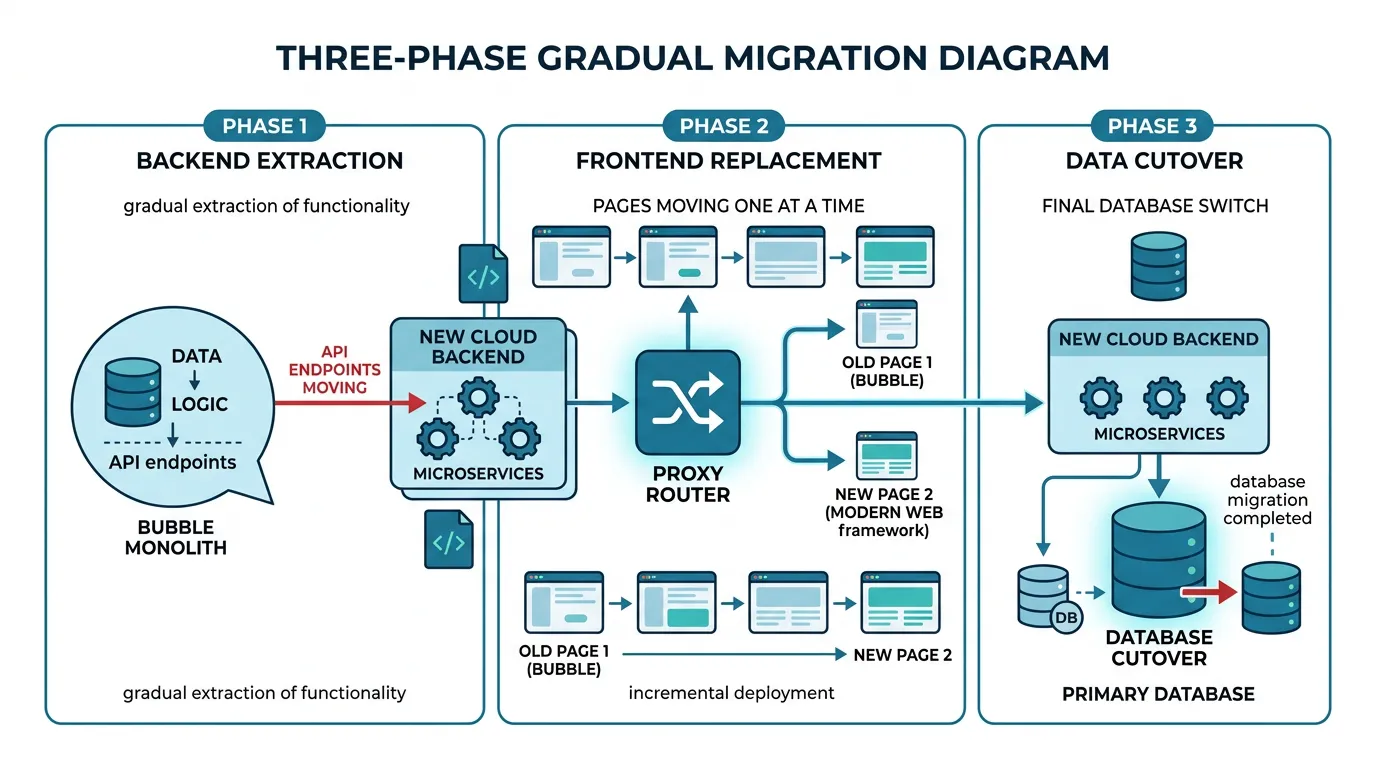
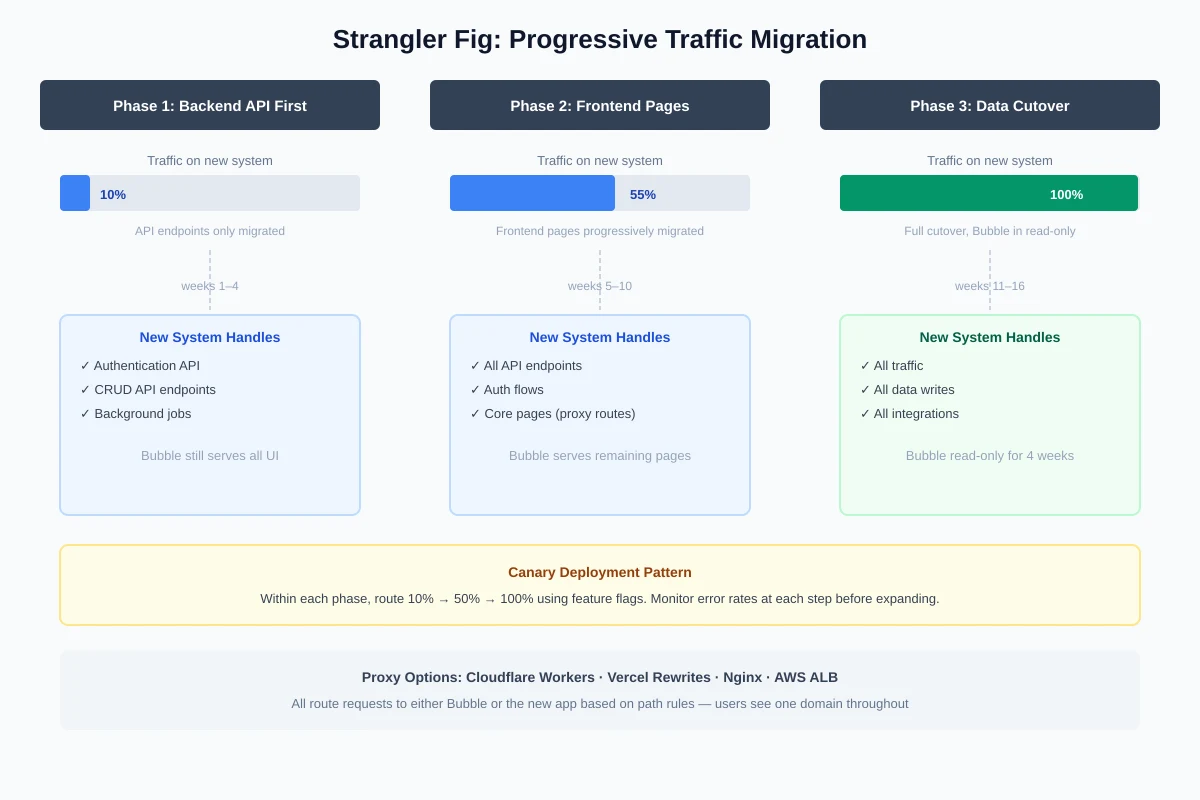
In a Bubble context, the strangler fig works like this: set up a proxy (Cloudflare Workers, Nginx, or Vercel rewrites) in front of your Bubble app. The proxy initially routes 100 percent of traffic to Bubble. As you build new components in custom code, update the proxy to route specific paths to the new system. Over weeks or months, more paths route to custom code and fewer to Bubble. Eventually, Bubble handles zero traffic and can be decommissioned.
Why Gradual Migration Reduces Risk
| Risk Factor | Big Bang | Gradual (Strangler Fig) |
|---|---|---|
| Downtime risk | High (cutover window) | Zero (always running) |
| Rollback scope | Entire system | Single component |
| Testing in production | First time at cutover | Each component tested independently |
| Team stress | Extreme (cutover weekend) | Moderate (continuous delivery) |
| User impact | All users at once | Gradual, can use feature flags |
| Timeline flexibility | Fixed deadline | Flexible, can pause between phases |
The Cash Flow Advantage
Big bang migration requires paying for both Bubble and custom code development for the entire project duration — 3 to 5 months of double spending before any return. Gradual migration produces value incrementally: each migrated component reduces Bubble dependency and can deliver immediate performance improvements. For bootstrapped or cash-constrained teams, this makes migration financially feasible.
Gradual migration adds complexity (proxy routing, shared auth, dual systems). For simple apps (under 15 data types, under 1,000 users), the big bang approach is faster and cheaper. For complex apps (20+ data types, 5K+ users, critical integrations), the reduced risk of gradual migration justifies the added complexity. Use the performance audit to determine your app's complexity tier.
Phase 1: Backend API Extraction
Start with the backend — it is the lowest-risk first step because users do not interact with it directly.
What Moves First
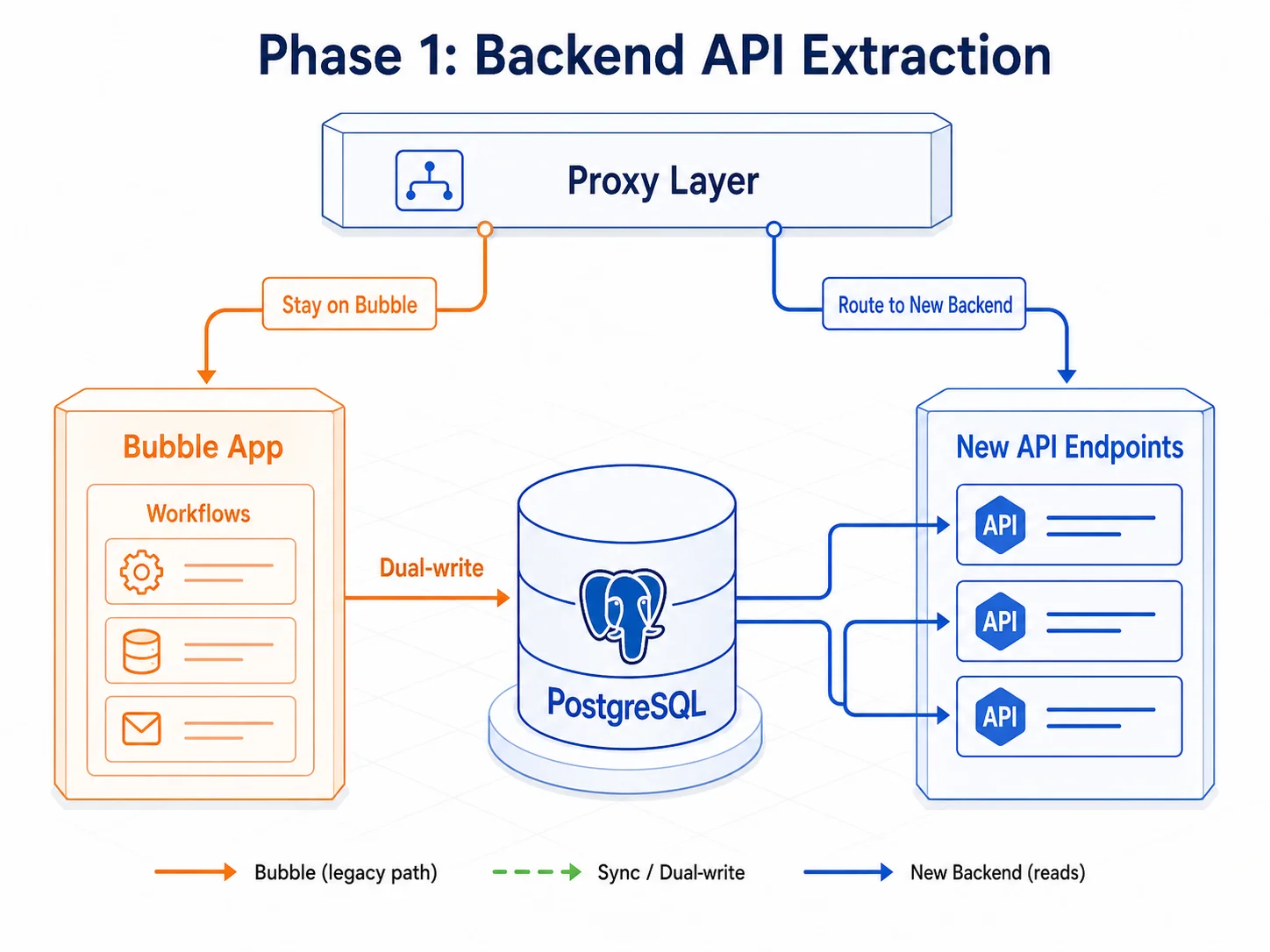
Build your new API endpoints alongside Bubble. Start with read-heavy, non-critical endpoints: data retrieval for reports, search functionality, or analytics queries. These endpoints can query a synced copy of your data in PostgreSQL while Bubble remains the source of truth for writes.
Data Synchronization
During Phase 1, Bubble is the write master and your new database is a read replica. Set up synchronization: Bubble workflows push data changes to your PostgreSQL database via API calls. Your new API endpoints read from PostgreSQL. This dual-write pattern lets you validate that your new API returns the same data as Bubble without risking data loss.
Proxy Routing
Configure your proxy to route API calls to the new backend. Start with one endpoint, verify parity, then add more. At any point, reverting a route back to Bubble is a single proxy configuration change — no code deployment needed.
Never route a second endpoint to the new system before the first endpoint has passed parity testing. Each endpoint's response — including data shape, field names, null handling, and pagination structure — must exactly match what Bubble returned. Differences that look minor in JSON produce broken UI components in the frontend. Run automated parity tests (request both systems with the same parameters, diff the responses) before each routing expansion.
Phase 2: Frontend Component Replacement
Once the backend API is stable, start replacing Bubble frontend pages with React/Next.js pages.
Page-by-Page Migration
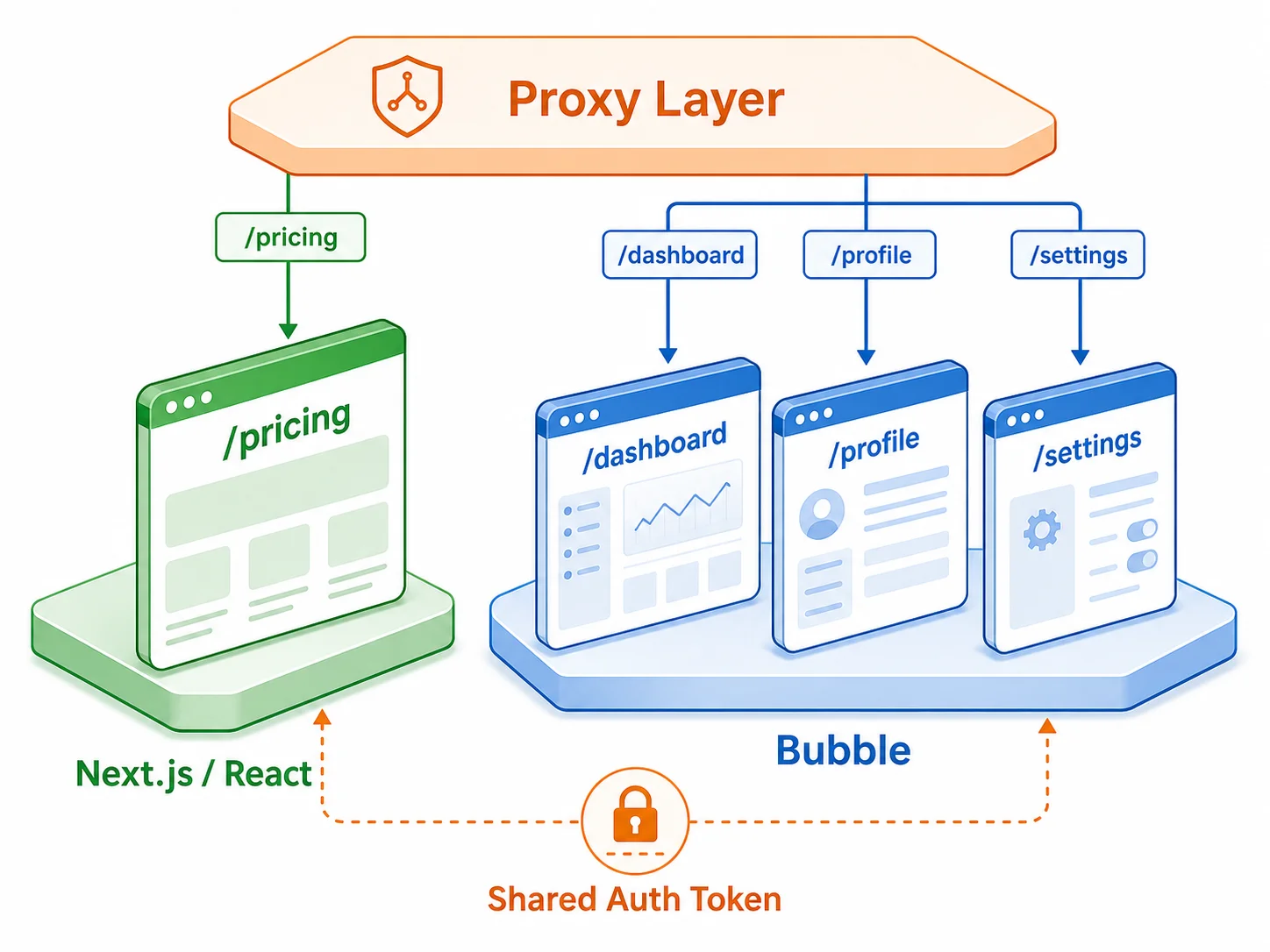
Replace one page at a time. Start with the page that has the most SEO value or the most performance problems. The proxy routes that specific path to your Next.js app. All other paths still go to Bubble. Users on the migrated page get the new experience. Users on other pages continue using Bubble. No one notices the transition.
Shared Authentication
The hardest part of gradual frontend migration is authentication. Users must be logged in to both systems seamlessly. Options: shared JWT tokens (your new system and Bubble accept the same token format), session proxy (the proxy adds authentication headers based on a shared session store), or SSO (both systems delegate auth to a shared provider like Auth0 or Supabase Auth).
Phase 3: Data Migration and Cutover
The final phase: switch the source of truth from Bubble to your new database.
Reverse the Write Master
Once all API endpoints and frontend pages are migrated, reverse the data flow: your new system becomes the write master and Bubble becomes the read-only archive. Stop sync from Bubble to PostgreSQL. Start sync from PostgreSQL to Bubble (if needed for remaining Bubble pages). When all traffic routes to the new system, Bubble can be decommissioned.
The Final Cutover
The final cutover in a gradual migration is anticlimactic — which is the point. By this stage, Bubble handles zero traffic. Decommissioning means removing the proxy routes to Bubble and downgrading the Bubble plan. No user-facing change. No downtime. No cutover weekend drama.
Proxy Routing and Shared Authentication
| Proxy Solution | Best For | Complexity | Cost |
|---|---|---|---|
| Cloudflare Workers | Path-based routing with edge logic | Low | Free tier available |
| Vercel Rewrites | Next.js apps with simple routing | Low | Included in Vercel plan |
| Nginx reverse proxy | Self-hosted with full control | Medium | Server cost only |
| AWS ALB + path rules | AWS-hosted infrastructure | Medium | $20–$50/mo |
Combine proxy routing with feature flags: route 10% of users to the new system first, monitor for errors, then increase to 50%, then 100%. This canary deployment pattern catches issues with a small user group before they affect everyone. Tools like LaunchDarkly, Flagsmith, or even a simple database flag make this straightforward.
Frequently Asked Questions
Q. How long does gradual migration take compared to big bang?
Total elapsed time is 20 to 50 percent longer because you are running two systems in parallel. But the risk is dramatically lower, and each phase delivers value independently. A 12-week big bang becomes a 16 to 18 week gradual migration — but with zero downtime, incremental validation, and the ability to pause between phases.
Q. Does gradual migration cost more?
Development cost is 10 to 20 percent higher due to proxy setup, shared auth, and data synchronization. However, the reduced risk of post-launch emergencies (which can cost several thousand dollars in emergency fixes and lost revenue) often makes gradual migration cheaper in total cost of ownership. For complex apps with high-value users, the risk reduction alone justifies the premium.
Q. Can any Bubble app use gradual migration?
Apps where the frontend and backend are tightly coupled (most Bubble apps) require the proxy approach described here. Apps that already use Bubble's API for external consumers are easier to migrate gradually because the API layer is already separated. The proxy adds the separation that Bubble does not natively provide.
Q. How do I handle data consistency between two systems?
During the dual-system phase, one system is the write master and the other is a read replica. Never allow writes to both systems for the same data type — this creates conflict resolution nightmares. Start with Bubble as write master, then flip to custom code as write master when you are ready. The transition is a single configuration change.
Q. What if I need to pause the migration mid-way?
This is the biggest advantage of gradual migration. You can pause at any phase boundary — your app works with some components on Bubble and some on custom code. If a business priority interrupts migration, the system continues operating in its current hybrid state until you resume. Big bang migration does not have this option.
Q. Is architecture documentation still needed for gradual migration?
Yes — arguably more so. Gradual migration requires understanding component boundaries: which data types, workflows, and integrations belong to which component, and which have cross-component dependencies. Your architecture documentation reveals these boundaries and dependencies, enabling you to plan phases that minimize cross-system complexity.
Migrate Gradually, Launch Continuously
- The strangler fig pattern eliminates cutover risk: Instead of a single high-stakes weekend, migrate one component at a time with zero downtime. Each component is independently tested, deployed, and rollbackable.
- Three phases: backend, frontend, data: Extract backend APIs first (lowest risk), replace frontend pages second (one at a time via proxy), and cut over data last (when all traffic routes to the new system).
- Proxy routing is the enabler: A proxy (Cloudflare Workers, Vercel rewrites, Nginx) sits in front of both systems and routes each path to the appropriate backend. Route changes are configuration, not deployment.
- Pausability is the killer feature: Gradual migration can pause at any phase boundary. The app runs in hybrid mode until you resume. For cash-constrained or resource-limited teams, this flexibility is invaluable.
- Architecture documentation defines phase boundaries: Understanding which components depend on which data types and integrations determines how you split the migration into phases. Document first, phase second, migrate third.
Not every migration needs a dramatic cutover. For complex apps with active users and revenue at stake, the strangler fig pattern replaces the big bang with a controlled transition — gradual, reversible, and always live.
Map Your Migration Phases with Architecture Data
Relis extracts your complete Bubble architecture — data types, workflows, API connectors, and their dependencies — so you can plan phase boundaries that minimize cross-system complexity.
Scan My App — FreeReady to Plan Your Migration?
Get a complete architecture blueprint — ERD, DDL, API docs, workflow specs — everything your developers need to start rebuilding.
Ready to Plan Your Migration?
Get a complete architecture blueprint — ERD, DDL, API docs, workflow specs — everything your developers need to start rebuilding.