
How a Freelancer Builds a Bubble Migration Practice with Relis
A composite freelancer case study: how a solo Bubble migration consultant turns Relis-extracted documentation into a sales differentiator, books $25K-$60K projects, and stops competing on hourly rate.
24 min read
The Bubble migration consulting market commoditized faster than the people in it noticed. Five years ago a freelancer who could read a Bubble app and write Node could charge a premium for the rare combination. Today that same combination is a checkbox on a hundred Upwork profiles. Discovery calls run the same script, quotes land in the same range, and clients pick on price because every proposal looks like the last one. The freelancer at the center of this composite case study did not out-skill the market. They changed what they put in the room first.
What changed was the order of operations. Most freelance migration pitches lead with credentials and end with a proposal that promises to map the architecture later. This consultant flipped the sequence: a free Relis extraction runs during the discovery call, the architecture diagrams arrive before the quote, and the proposal is written against the actual four-layer surface area of the app. The result was not just better proposals. It was a different kind of client agreeing to a different kind of contract.
From Generalist to Migration Specialist
The composite consultant at the center of this case study is an independent developer with four to seven years of experience, a former employee at a no-code agency, now operating solo. Their early career was pure Bubble build work — internal tools, MVP features, agency overflow. The pivot toward migration specifically came from an uncomfortable observation: the same clients they had built Bubble apps for two years earlier were now asking how to leave Bubble. The question kept arriving in their inbox. The market signal was loud enough to act on.
The first migration project under the new positioning was, by their account, a near-disaster. The proposal estimated three months. The actual delivery took five. The overrun was not a coding problem; it was a discovery problem. The agency-shaped quote had assumed a clean schema and a small number of backend workflows, and the actual app had years of accumulated database hygiene debt and dozens of recurring workflows nobody had documented. The consultant ate the difference because the contract was fixed-price and they had not yet learned how to scope a Bubble migration honestly.

"I lost about fourteen thousand dollars on that first migration because I quoted the app I thought I was looking at, not the app I was actually looking at. The client was happy. I was bleeding. That gap was the whole problem."
— Composite freelancer, synthesized from recurring statements
The lesson the consultant drew from that first project was specific: the bottleneck of a freelance migration practice is not coding speed or technical depth. It is the cost of accurately scoping work before signing a contract. Discovery is unbillable in this business unless you charge for it explicitly, and most clients will not pay a stranger for a discovery audit on faith. So discovery either gets skipped, gets compressed into a one-hour call, or gets done for free and absorbed as a marketing expense. None of those are good answers. All three lead to the same outcome: quotes that miss what the app actually contains.
Specializing in migration meant the consultant could no longer treat discovery as a side cost. It had to become a repeatable, low-cost, low-time process that produced enough information to scope honestly. That is the gap Relis filled, but the consultant did not know that yet — they tried two manual approaches first. Both involved spending two to four working days inside a client's Bubble editor with a notebook and a screen recorder, and both produced documents that were too thin to base a contract on.
The Sales Playbook: First Meeting Demo
The current sales playbook starts with a thirty-minute discovery call. Within the first ten minutes of that call, the consultant asks the prospect for collaborator-level access to their Bubble app and runs a Relis extraction in a shared screen. The extraction completes while the call is still happening — typically in under ten minutes for a medium-complexity app, per the Relis Features page. By minute twenty of the call, the consultant is walking the prospect through their own architecture: the entity-relationship diagram, the API connector inventory, the backend workflow list, the app settings flags. This is the moment that converts.
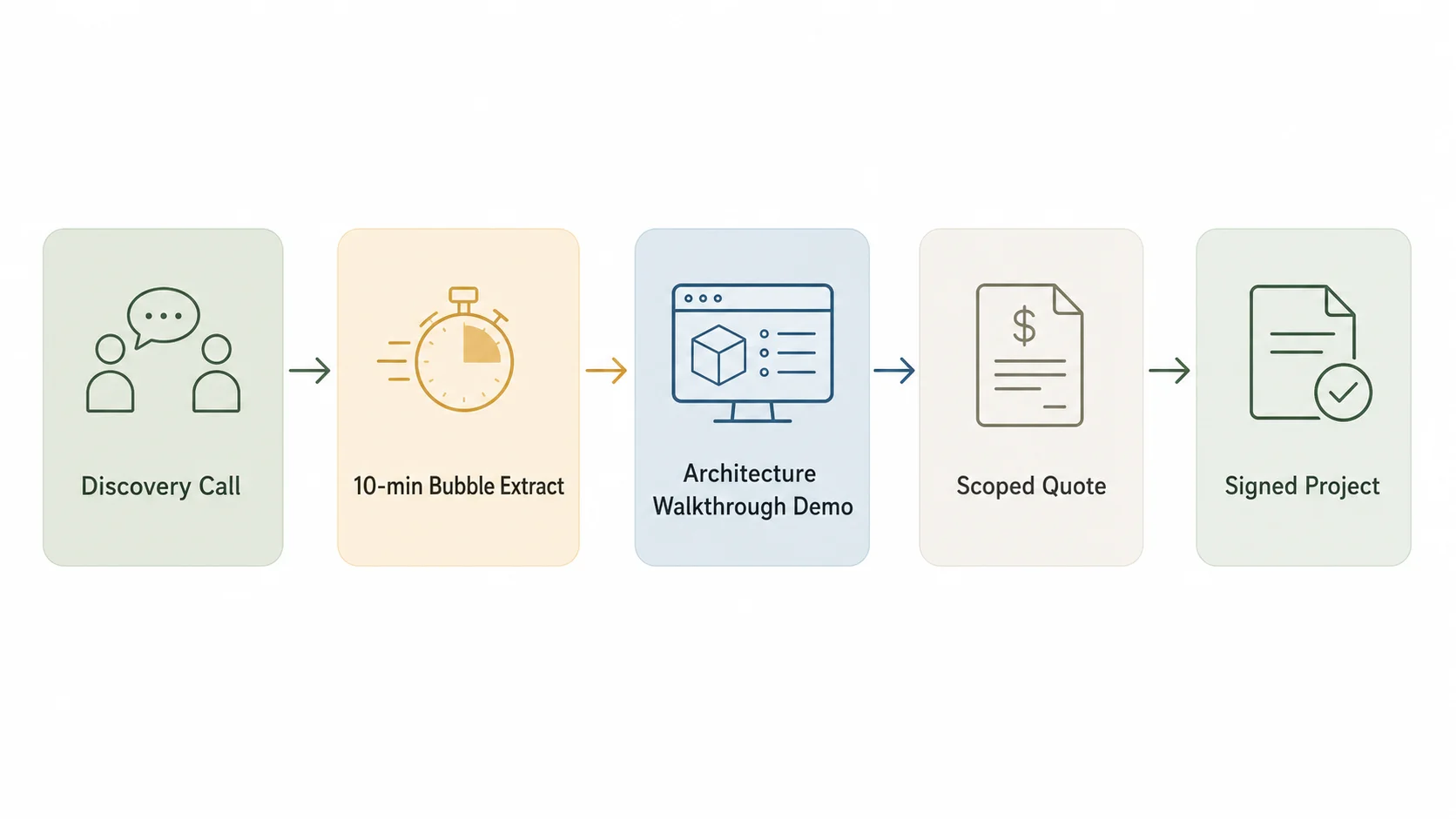
"The first time I did this on a discovery call, the founder went quiet for about thirty seconds while I clicked through the API connector list. Then she said, 'Wait — you can show me this in ten minutes? My current dev told me it would take two weeks to even tell me what we have.' That call closed three days later at almost twice my old rate."
— Composite freelancer, synthesized from recurring statements
The reason this demo converts is not novelty. It is a status transfer. The consultant arrives at the call positioned as a vendor competing for work, and the architecture walkthrough rotates the room so they are now the only person who can see the whole app. The client's existing developers, the previous agency they hired, and any other freelancers they are talking to have not done this. They have not even offered to do this. By the end of the demo the question has shifted from "should we hire you" to "can you start in two weeks."
The order of artifacts shown matters more than the consultant initially expected. Leading with the ERD works for technical founders and CTOs because they immediately see foreign keys and start asking about denormalization. Leading with the workflow inventory works better for product founders because they recognize the names of their own features in the workflow list and start estimating their own scope. The consultant rotates the lead artifact based on who is on the call, but the full nine-document deliverable package always gets walked through before the call ends.
Roughly fifteen minutes of preparation per call, plus the Relis extraction time, plus a thirty-minute call. The Relis subscription cost amortizes across all discovery calls in the month. On a typical month with eight to twelve discovery calls, the consultant reports the per-call cost of running the demo lands in the very low double digits. Compared to a four-day manual discovery audit at any reasonable hourly rate, the math is not close.
Quote Accuracy Is the Real Product
The architecture demo wins the deal. Quote accuracy keeps the deal profitable. Before Relis, the consultant's fixed-price quotes were drifting roughly twenty to forty percent over actual delivery cost — a margin-eroding pattern that any agency veteran will recognize. After Relis, that gap narrowed materially because the proposal was written against an inventory of real artifacts: every data type, every backend workflow, every external API integration counted before the contract was signed.
| Indicator | Before Relis (manual discovery) | After Relis (extraction-led discovery) |
|---|---|---|
| Discovery time per project | Two to four working days | Roughly one hour, including the extraction |
| Quote vs actual cost gap | Quotes typically drifted twenty to forty percent over | Drift compressed into a much narrower band — most projects landing within their stated contingency |
| Mid-project scope surprises | Common — undocumented workflows and API edges | Rare — surprises now mostly come from frontend complexity, not backend hidden surface |
| Client satisfaction at handoff | Mixed, often colored by overruns | Higher — fewer "you didn't tell me about that" conversations |
| Re-engagement rate | Lower — clients reluctant to repeat the experience | Higher — most projects yield at least one referral or follow-on |
"My old quotes were aspirational. My new quotes are inventory. The difference is not that I got better at coding. The difference is that I stopped guessing what was in the app."
— Composite freelancer, synthesized from recurring statements
The downstream effect of accurate quotes is the part most freelancers underestimate. Scope creep is the largest hidden cost in fixed-price migration work, and scope creep almost always traces to discovery gaps — workflows you did not see, APIs you did not list, privacy rules you did not enumerate. Closing the discovery gap upstream means the consultant rarely needs to renegotiate mid-project, which means the client trust curve trends up rather than down across the engagement, which means the post-project referral conversation happens naturally instead of being a recovery pitch. Trust compounds. So does the pipeline.
The cost mechanics of this pattern align with the broader migration cost structure documented in our analysis of Bubble migration economics. When freelancers underprice migration work, it is almost always because they did not see the app's complete surface area before signing. The composite consultant's experience confirms the same direction at the individual-practitioner scale.
New Client Channels: How Differentiation Compounds
The first-order effect of the architecture-first sales motion is win rate on individual deals. The second-order effect is the lead pipeline itself. Once the consultant started winning a noticeable share of competitive bake-offs, two new things happened to their inbound channel composition: referral rate climbed sharply, and inbound from content marketing started arriving with much higher intent than before.
"I used to chase leads. Now they pre-qualify themselves. Half my new prospects show up on the discovery call already saying, 'My friend hired you and showed me their ERD — can you do that for us?' That sentence is the entire sales pitch."
— Composite freelancer, synthesized from recurring statements
Referral lift is the easier change to explain. A freelancer who finishes a migration on budget, with documentation that survives the project, leaves behind a champion at the client. That champion shows the architecture diagrams to peers in their network — sometimes within the same investor portfolio, sometimes within a Slack community, sometimes inside a single accelerator cohort — and the next prospect arrives already convinced the consultant is competent. The referral conversation does not need to relitigate that question.
Content marketing lift is more interesting because it is structurally tied to the deliverable. The consultant started publishing redacted case studies on LinkedIn — anonymized ERDs, before-and-after workflow inventories, scope diagrams of recently-migrated apps — and the engagement on those posts dwarfed the engagement on their old "tips and tricks" Bubble content. Architecture artifacts are inherently more credible content than opinions, because the artifacts are evidence that the work happened. Other freelancers post advice. This consultant posted receipts.
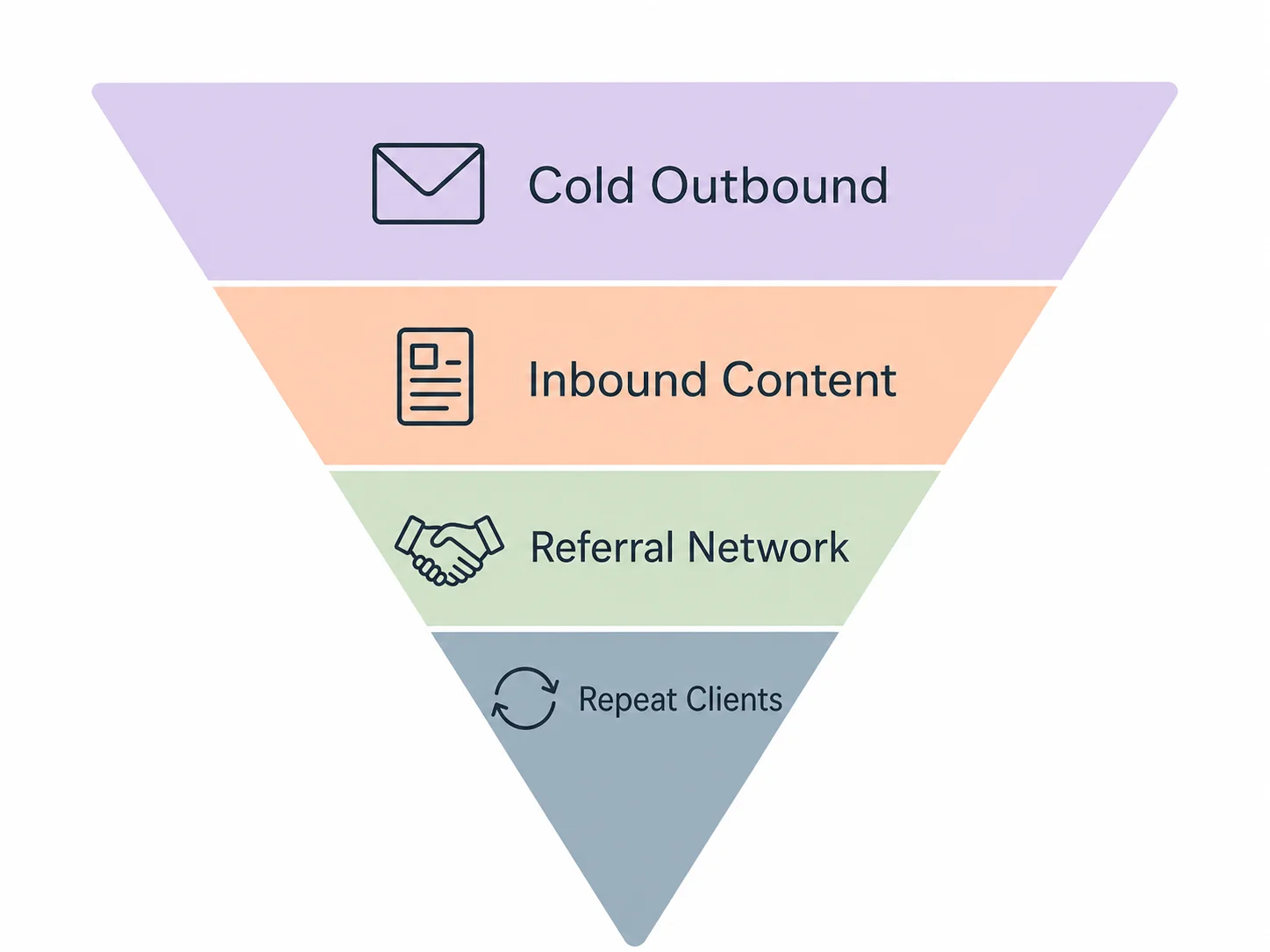
The composite ratio reported across the consultants who fed this case study is roughly: pre-Relis pipeline mix skewed heavily toward cold outbound and platform-marketplace work; post-Relis pipeline mix shifted markedly toward referrals and inbound content, with cold outbound shrinking to a small minority of new conversations. This is the difference between a freelance practice and a freelance hustle. The hustle re-fills the top of funnel every Monday. The practice has a top of funnel that re-fills itself.
The single highest-leverage marketing tactic in this composite is offering free architecture extracts to qualified prospects in exchange for permission to anonymize and publish the redacted version. Each extract becomes both a sales artifact and a content artifact. Two outputs from one operation. This is not a tactic the consultant would recommend to someone who has not yet completed at least one migration successfully — credibility has to be earned before it can be marketed.
Pricing Power: From Hourly to Project-Priced
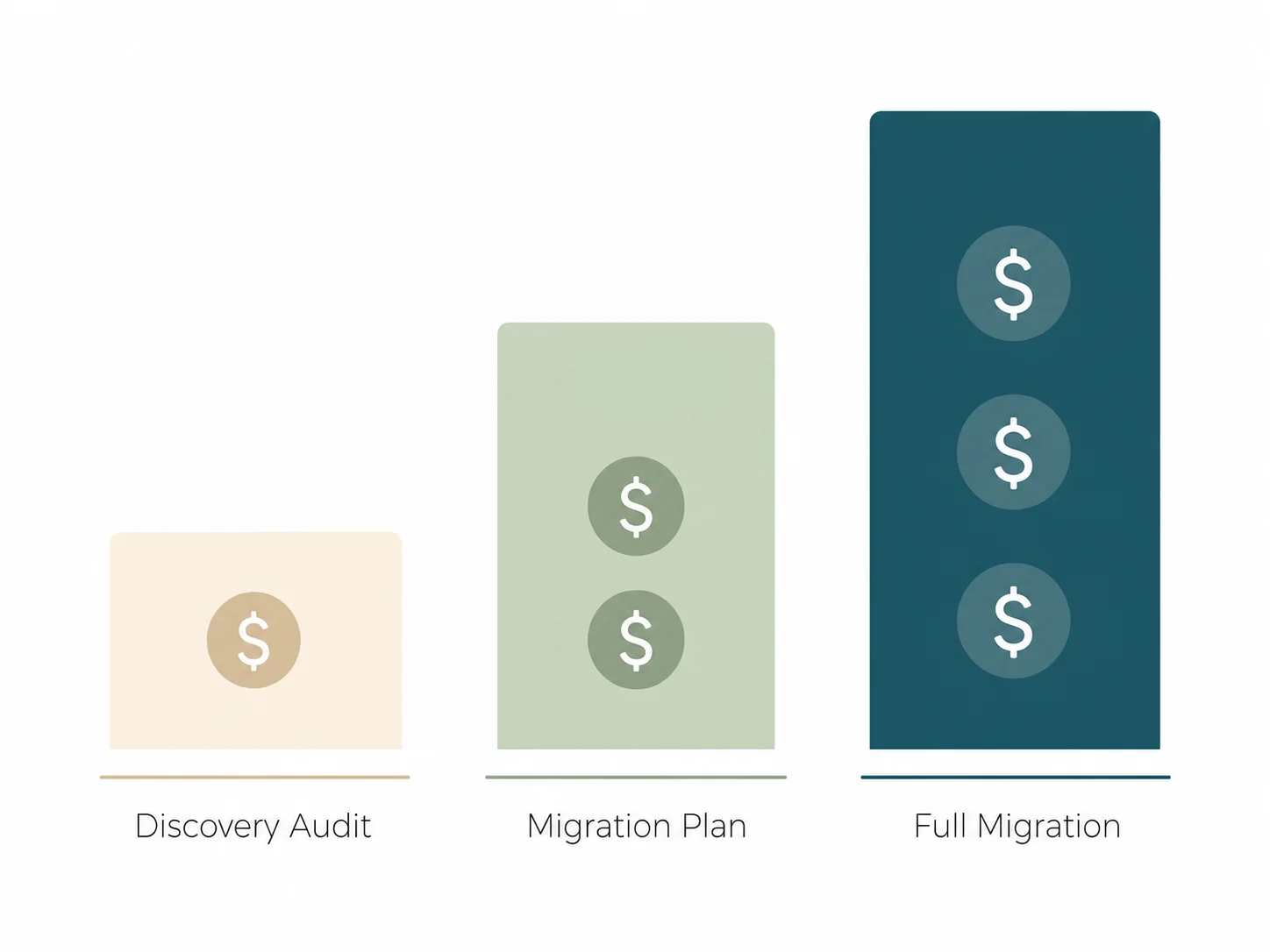
The hourly-rate trap is the freelancer-specific version of commoditization. As long as the unit of sale is hours, every prospect compares quotes on rate, and every rate increase feels like a price hike. The way out is to change what is being sold. The composite consultant moved from hourly billing to three productized tiers — a Discovery Audit, a Migration Plan, and a Full Migration build — each priced as a project deliverable rather than a labor pool. The hourly column disappeared from their proposals entirely.
The price ranges associated with this tiering are in the realm of $25K-$60K for full migration projects, with discovery audits and migration plans priced as smaller fixed-fee engagements that often funnel into the larger build. We are reporting these as ranges per the composite agreement, and the actual numbers vary substantially with the size of the Bubble app, the target stack, and the consultant's positioning. The directional point matters more than the exact figures: when the proposal leads with an architecture artifact rather than a rate card, the conversation shifts from "how cheap" to "how soon."
"The day I deleted my hourly rate from my website, I lost two prospects who were shopping on price. I gained six who were shopping on outcomes. The freelancers I know who are still racing to the bottom on Upwork are racing against people who do not own a Relis subscription, and that is the entire reason they are still racing."
— Composite freelancer, synthesized from recurring statements
Project pricing only works if the project is scopable, which closes the loop on the discovery section: accurate scoping is the prerequisite for fixed pricing, and fixed pricing is the prerequisite for premium positioning, and premium positioning is the prerequisite for escaping the hourly market. Each of those steps has to land for the next one to work. Skipping discovery quality and trying to charge premium fixed prices anyway is how a freelance migration practice goes bankrupt in the second project.
The pricing change also reframes Relis itself for the consultant. The subscription is no longer a tool cost; it is a positioning expense. It is the one piece of equipment that lets them write proposals against an inventory rather than against a guess, which is the lever that lets them charge a project price rather than an hour price. Treating Relis as a marketing line item rather than a development tool is a small mental shift with a large consequence on how the consultant defends the spend internally.
Advice for Other Freelancers Starting This Practice
The single most-asked question the composite consultant gets from other freelancers thinking about migration specialty is some version of "where do I start." The honest answer is that the first thirty days are not about coding capability — most freelancers reading this already have enough technical skill. The first thirty days are about narrowing the niche, demonstrating the deliverable, and making the discovery loop repeatable. The composite playbook condenses to four steps.
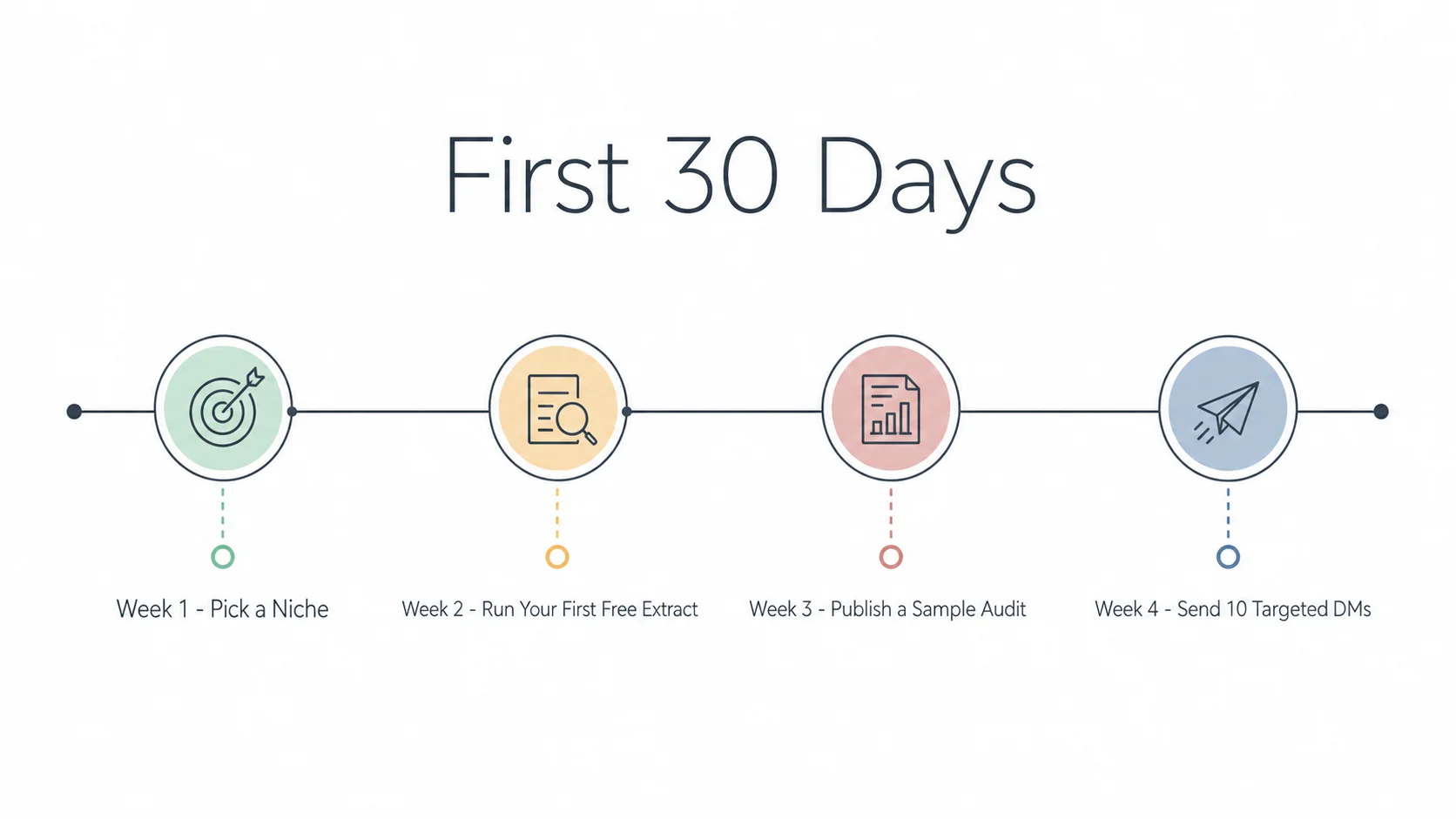
Step one is to pick a niche narrower than "Bubble migration." Bubble-to-Supabase for SaaS founders is a niche. Bubble-to-Next.js for marketplaces is a niche. "Migration consulting" is a category, and category-level positioning loses to specialist-level positioning every time. The composite consultants who landed premium work all picked a slice and stayed in it long enough to be searchable.
Step two is to run a free Relis extract on a known Bubble app — a friend's, a side project, a publicly-listed agency portfolio piece (with permission) — and produce the redacted artifact pack you would deliver to a paying client. Do not skip this. The first time you walk a prospect through an architecture diagram, you want to have already done it twice in private. The demo motion only works if it is rehearsed.
Step three is to publish the redacted artifact pack as a sample case study — LinkedIn post, blog, portfolio page, whichever channel matches your niche. The artifact does not need to be impressive. It needs to be specific. A small redacted ERD beats a long opinion essay because the ERD is evidence and the essay is not.
Step four is to send ten direct messages to founders in your niche offering a free architecture extract — not a free consultation, not a discovery call, an architecture extract. The framing is critical. "Let me run your app through Relis and walk you through the diagrams" is a concrete offer with a defined deliverable. "Want to chat about migration?" is a request for the prospect's time, which is the offer every other freelancer is making.
"If I were starting over today, I would not start with a website or a price list or even a logo. I would pick one specific Bubble migration target stack, run free extractions for ten founders in that exact niche, and let two or three of them turn into paid work. Everything else is downstream of that loop."
— Composite freelancer, synthesized from recurring statements
The composite freelancers who launched their migration practices this way report the first paying engagement typically arrived within the first six to twelve weeks of running the loop consistently. The freelancers who tried to launch by building a brand, a website, or a content calendar first reported much longer timelines and substantially less clarity on what was actually working. Sequence matters here. Receipts before opinions, deliverables before brand, demos before pitches.
Frequently Asked Questions
Q. Do I need to be a senior developer to start a Bubble migration consulting practice?
You need enough development skill to deliver a migration honestly, but the differentiator is process, not seniority. The freelancers in this composite range from four to seven years of experience. The bottleneck is whether you can scope a Bubble app accurately before signing — which is a discovery skill, not a coding skill — and whether you can deliver a documented migration that survives the handoff. If you have shipped at least one custom-stack project that you would still maintain today, you have enough technical floor.
Q. Can I afford a Relis subscription from day one of a freelance practice?
Treat the subscription as a sales-and-marketing line item, not a development expense. The unit economics that justify the spend are: cost per discovery call (low), discovery time saved per call (high), close rate lift on competitive deals (material). On any reasonable freelance hourly rate, the time saved on a single closed migration project pays for many months of subscription. Run the math against your own pipeline before deciding — see the Features page for what each tier includes.
Q. How do I get my first migration client without a portfolio?
The composite playbook in section six is the answer: pick a niche, run a free extract on a known app to rehearse the demo, publish the redacted artifact, and send ten targeted direct messages offering free architecture extractions. Do not start with a price list or a brand. Start with deliverables. Founders are far more willing to spend ten minutes letting you run an extract than they are to schedule a thirty-minute discovery call with another generic consultant.
Q. Should I show prospects the Relis outputs before they sign with me?
Yes, with one caveat: deliver the architecture walkthrough as a guided demo, not as a raw export. The artifact is more valuable when it is contextualized — the consultant pointing out which workflows are likely to translate cleanly, which API integrations are likely to break, which privacy rules are likely to need redesign. Handing over a raw export without commentary is a commodity. Walking a founder through their own app's architecture is a sales motion.
Q. Should I charge hourly or project-priced for migration work?
Project-priced, once you can scope accurately. Hourly billing caps your upside, anchors the conversation on rate rather than outcome, and keeps you in the commoditized end of the market. Project pricing only works if your discovery process is reliable enough that you can quote without underestimating, which is the entire reason the architecture-first sales motion matters. The two changes have to happen together.
Q. Will this approach still work if everyone else starts using it?
The architecture-first sales motion will eventually become table stakes for serious migration freelancers — that is the natural evolution of the category. The compounding advantage shifts from "having the artifacts" to "having a track record of delivering against them." A documented migration that the client still uses two years later is the asset that survives commoditization. Tools commoditize faster than reputations.
The Pitch Deck Is an ERD
The composite freelancer at the center of this case study did not invent a new technical capability. They moved an existing artifact — the architecture diagram — earlier in the sales conversation, and the entire downstream economics of the practice rearranged around that single change. Discovery cost dropped. Quote accuracy improved. Project pricing replaced hourly billing. Referral flow climbed. Cold outbound shrank. None of these were independent wins. They were the same win, traveling through a freelance practice in sequence.
The lesson is not that Relis is a magic differentiator. It is that architecture artifacts are a different category of sales asset than the artifacts most migration freelancers bring to a discovery call. Slides argue. Diagrams describe. When a founder sees their own ERD on a screen ten minutes into a first call, the proposal that follows is no longer a vendor pitch — it is a contract for work the founder already understands. That is the conversion. Everything else in this case study is downstream of getting that artifact into the room first.
The freelancers who will dominate Bubble migration consulting over the next two years are not the ones with the cleanest websites, the most credentials, or the most aggressive cold-outreach sequences. They are the ones whose discovery process produces evidence rather than promises. The cost of producing that evidence used to be measured in days of unbillable work. It now takes ten minutes. The freelancers who notice this gap and exploit it consistently are the ones who will stop competing on rate. The ones who do not notice will keep racing to the bottom of an Upwork search result until they exit the category.
Run the Demo This Composite Freelancer Runs
Relis extracts your prospect's complete Bubble architecture in under ten minutes — ERD, API spec, workflow inventory, app settings, nine documents in total. Walk founders through their own architecture before you write a single line of proposal copy. Free for your first project.
Start Free ExtractionYour Bubble App Has No Export Button — Until Now
Relis extracts your complete Bubble.io architecture automatically. ERD diagrams, DDL scripts, API docs, workflow specs — all in under 10 minutes.
Your Bubble App Has No Export Button — Until Now
Relis extracts your complete Bubble.io architecture automatically. ERD diagrams, DDL scripts, API docs, workflow specs — all in under 10 minutes.