
Case Study: SaaS Startup Cuts Migration Quote from 6 Months to 3
A composite Series A SaaS founder shows how Relis-extracted documentation halved the Bubble migration estimate, accelerated engineer onboarding, and changed how investors perceived their technical debt.
21 min read
This case study is a composite drawn from multiple founder conversations and engagements we have advised on. Names, companies, and exact figures are illustrative; the patterns and decision sequence reflect what we have seen across SaaS migrations off Bubble. No single founder is being quoted. We wrote it this way so the lessons are concrete without exposing anyone's cap table.
Migration quotes drift for the same boring reason most software estimates drift: the estimator is guessing at the parts they cannot see. Bubble apps are unusually good at hiding their parts. The data layer looks like a list. The privacy rules live in another tab. The backend workflows are a separate world from the API connector. And page-level workflows — the ones the founder built first and forgot about — quietly accumulate logic that nobody documents.
The pattern this case study compresses is the one we keep watching across SaaS migrations off Bubble: an initial quote from a competent agency, around six months, with a wide error band. Then the founder runs an automated extraction. Suddenly the agency has an ERD, a backend workflow inventory, and an API contract spec they can read in twenty minutes. The quote drops, the error band shrinks, and the conversation pivots from "we will need to discover this" to "we will need to translate this." Six months becomes three. This piece walks through how that happens, what specifically changes, and why the savings are not really about timeline — they are about the four layers of a Bubble app finally being visible at the same time. We will also be honest about what does not change. (For the dollar side of the same trade, see what Bubble migrations actually cost.)
Background: A Series A SaaS at the Tipping Point
The composite company is a B2B SaaS roughly eighteen months past their seed round and nine months into a Series A. Annual recurring revenue sits in the low single-digit millions — the kind of number that makes the next investor question "and how does this scale on Bubble?" feel less academic. The team is small: twelve people, three of them engineers (one full-stack lead, two product engineers), one designer, the rest split between go-to-market and customer success. The product is a workflow tool with a meaningful integrations surface — about a dozen API Connector calls for inbound data and outbound webhooks.
The Bubble app at trigger time has roughly forty data types, several hundred page-level workflows, and a backend workflow library the founder describes — affectionately, defensively — as "fine, mostly." Workload Units consumption has crept upward across the last two billing cycles. Two things hit in the same week: a Workload Units overage notice that the finance lead forwarded with the subject line "is this real," and a Series A board observer asking, in passing, what the migration plan looked like.

"The overage email and the board question landed in the same week. I think that was the moment we stopped pretending we had a year to think about it."
— Composite founder, paraphrased from multiple Series A B2B SaaS conversations
The trigger here is not unique. It is two pressures arriving on the same calendar: cost pressure (Workload Units) and capital pressure (the next investor wanting to see a credible technical roadmap). One pressure alone is usually survivable. Two together is what moves migration from "someday" to "this quarter." For founders watching the same convergence, our pre-pitch self-audit covers the second pressure in detail.
Before the Outputs: The "First Quote" Problem
The composite founder did the responsible thing first: they asked two agencies for a migration estimate. Both were competent shops with public Bubble migration case studies. Both came back with quotes in the same range — somewhere around six months of calendar time, a team of two to three engineers, and a stated error band of plus-or-minus thirty percent. Both quotes had the same gentle hedge in the cover note: "this assumes typical complexity for an app of this size."
"Typical complexity" is the phrase that hides the discovery cost. When an agency cannot see your privacy rules, your backend workflows, and your API connector configuration in a single pass, they have to price for the worst plausible version of each of those layers. That is not them being adversarial — it is them being responsible. A six-month quote with a thirty percent band is the rational output of an estimator who has seen one screen-share, two PDFs of database screenshots, and a Notion page titled "I think this is most of the workflows."
What was actually feeding that estimate, on the founder's side, was a workflow we have seen at almost every SaaS in this position:
- Manual screenshots of every data type, taken on a Saturday by the technical co-founder.
- A Notion document called "API endpoints" that listed eight of the twelve actual API Connector calls.
- A single-tab spreadsheet of "things the app does" that conflated user-facing features with backend jobs.
- Privacy rules that the founder remembered writing but could not, under pressure, fully reconstruct.
- Backend workflows nobody had inventoried since the Series A diligence pass nine months earlier.
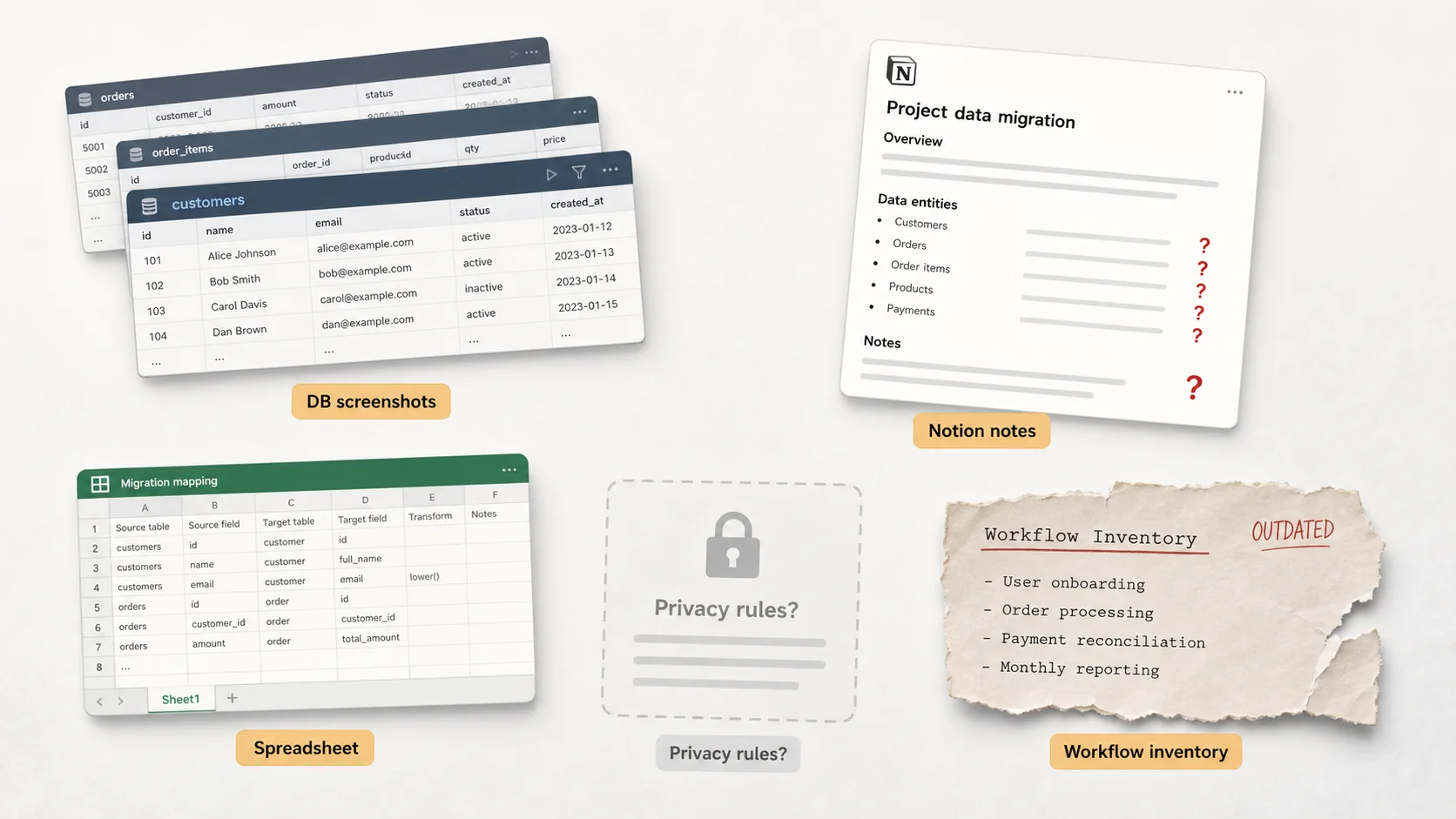
"I had a Notion page I was very proud of. It turned out to be missing four of our twelve integrations, and I genuinely did not know that until the agency asked the wrong question."
— Composite founder, paraphrased
The agencies were not pricing the migration. They were pricing the discovery work plus the migration. That is the "first quote" problem: you are paying for them to find out what your app does. And because they have not yet found out, they hedge — which they should. The fix is not to argue the hedge down. The fix is to remove the discovery work.
If your migration quote has a wide error band, do not negotiate the band. Reduce the unknowns the band is protecting against. Discovery work moves out of the agency's risk column and into a flat-cost extraction step you can run yourself before the next conversation.
The Switch: How Nine Extracted Documents Changed the Conversation
The composite founder ran an automated extraction. The Relis pipeline produced nine artifacts in roughly ten minutes — an ERD, an API contract spec, a backend workflow inventory, page workflow documentation, a privacy rules summary, a plugin and dependency manifest, an option-set/static data export, a settings/config snapshot, and an architecture overview that stitched the other eight together. (The Features page is the source of truth for the current output set.) The founder dropped the bundle into the next agency call.
The conversation changed in three places. First, the agency stopped asking discovery questions and started asking translation questions: not "how many integrations" but "what is the rate-limit behavior of this third one." Second, the lead engineer scrolled to the backend workflow inventory and audibly relaxed — they could see the surface area. Third, the quote came back inside a week with a tighter band and a halved timeline.
| Dimension | Before extraction | After extraction |
|---|---|---|
| Calendar timeline | ~6 months | ~3 months |
| Stated error band | ±30% | ±10–15% |
| Discovery phase | 3–4 weeks priced in | ~3 days, mostly verification |
| Required founder hours | ~40 hours of Q&A | ~8 hours of clarification |
| Engineering team needed | 2–3 senior engineers | 2 engineers, one mid-level |
| Risk reserve in quote | "typical complexity" hedge | Itemized against ERD + workflow list |
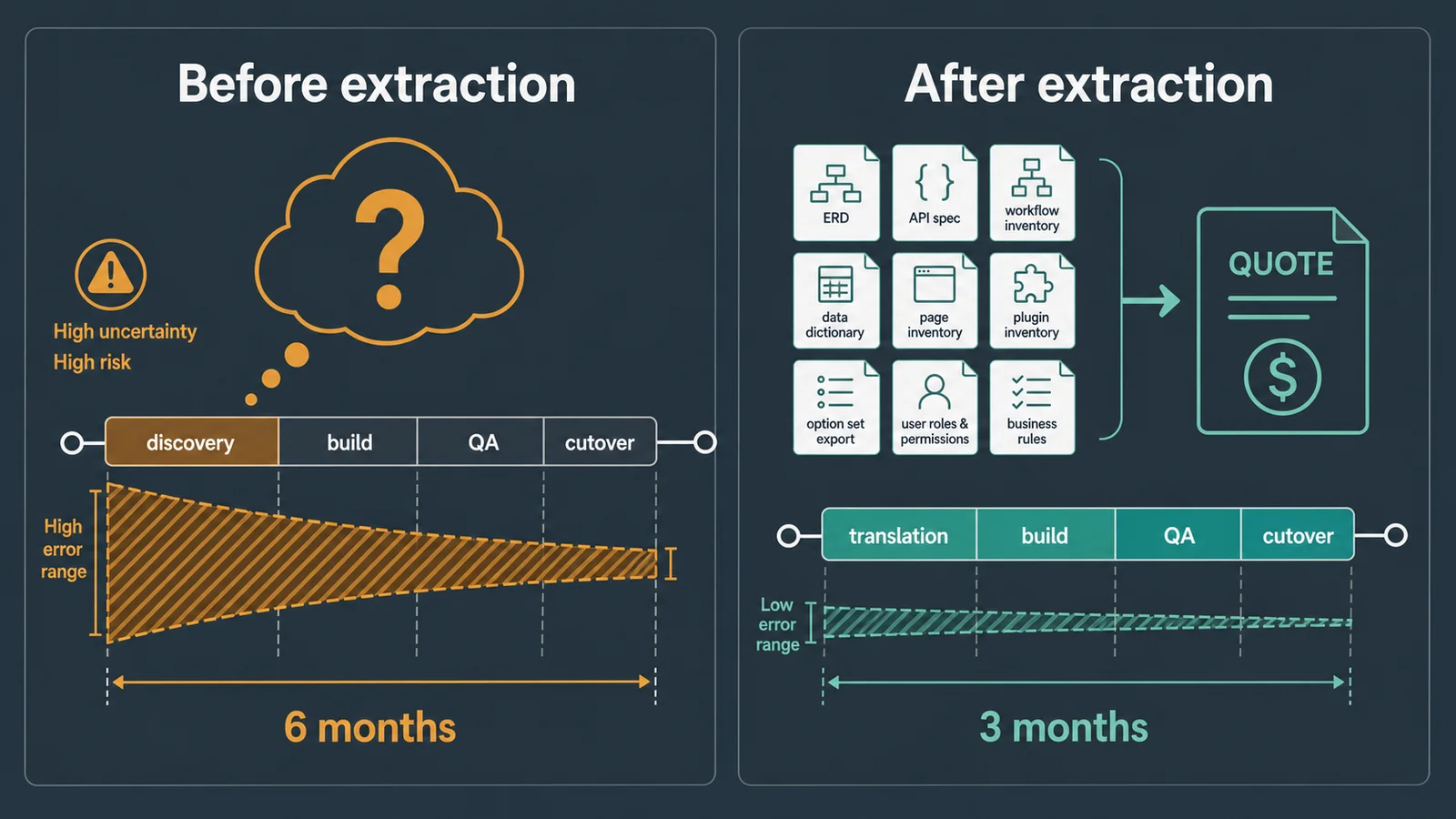
Two of the nine outputs did most of the heavy lifting. The ERD and the backend workflow inventory together account for the majority of the variance the agency had been hedging against. An ERD that names every data type and relationship kills the data-modeling unknown. A backend workflow inventory — not just a list, but the input/output shape of each workflow — kills the logic-discovery unknown. The other seven outputs (API contracts, privacy rules summary, page workflows, plugins, option sets, config, architecture overview) reduce risk further, but the ERD plus the workflow inventory is where the timeline collapses.
"The lead engineer on their side scrolled the workflow inventory for about ninety seconds and said 'okay, this is a normal app.' That sentence was worth about three months of calendar."
— Composite founder, paraphrased
Engineer Onboarding: Days, Not Weeks
The second-order effect, the one the founder did not predict, was on engineer onboarding. The agency's two engineers ramped in days rather than weeks. The same documentation pack that compressed the quote also compressed the onboarding curve, because the documentation answered exactly the questions a new engineer asks in their first week — what are the entities, how do they relate, what does the system do on a schedule, where does it talk to the outside world, who is allowed to see what.
The composite founder estimates they recovered roughly twenty hours of their own time across the first month — time that would otherwise have gone into pairing, screen-shares, and "let me show you what this workflow actually does" conversations. That is not free time. That is time the founder used on customer calls and on the next quarterly board update. (For more on the second-order team effects of migration documentation, see our guide on building an engineering team off Bubble.)
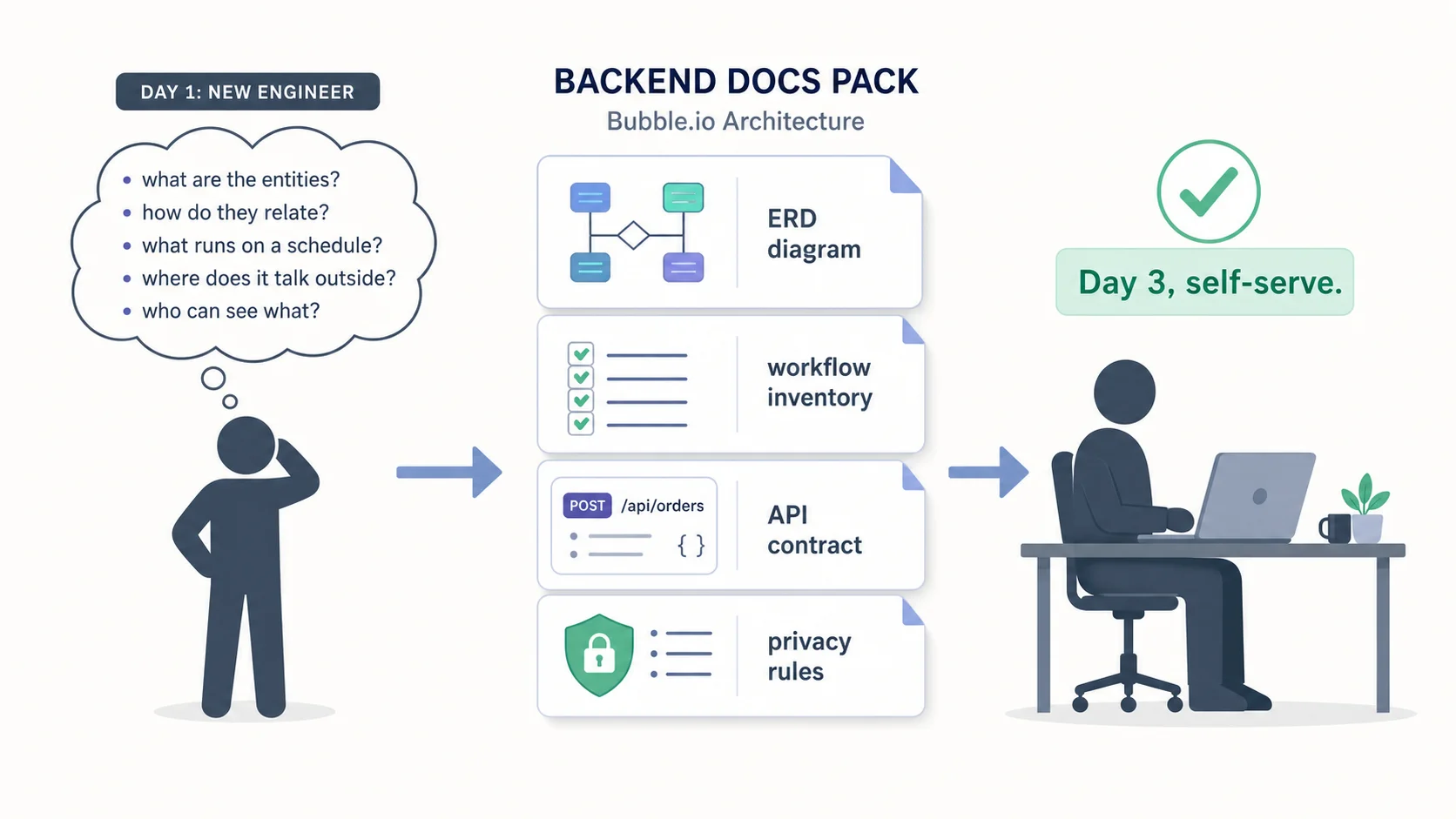
"I stopped being the bottleneck on day three. They had the ERD on one screen and the workflow inventory on another, and they were just translating. I went back to selling."
— Composite founder, paraphrased
Documentation is not self-serve when it is just present. It is self-serve when an engineer can answer their own next question without scheduling a call with the founder. The ERD plus the workflow inventory crosses that threshold for most B2B SaaS Bubble apps. The other seven outputs become the long-tail reference set.
Investors See What Engineers See
The third effect was the one that surprised the founder most, because it was the one they were not optimizing for. At the next board update, the same observer who had asked about the migration plan asked again. The founder shared the architecture overview, the ERD, and a one-page summary of the migration timeline derived from the agency's revised quote. The observer's tone changed inside the same meeting — from "do you have a plan" to "this looks like a plan I have seen before from companies who shipped it."
This is the part that does not show up in a Gantt chart. Investors at Series A do not need you to have already migrated. They need to see that you understand your own system well enough that the migration is a project, not a discovery exercise. The architecture documentation answers the implicit question — "do these founders know what they have built" — in the same artifact that answers the explicit question, "what is the migration timeline." Our investor due diligence guide covers the eight questions investors actually ask in this conversation.
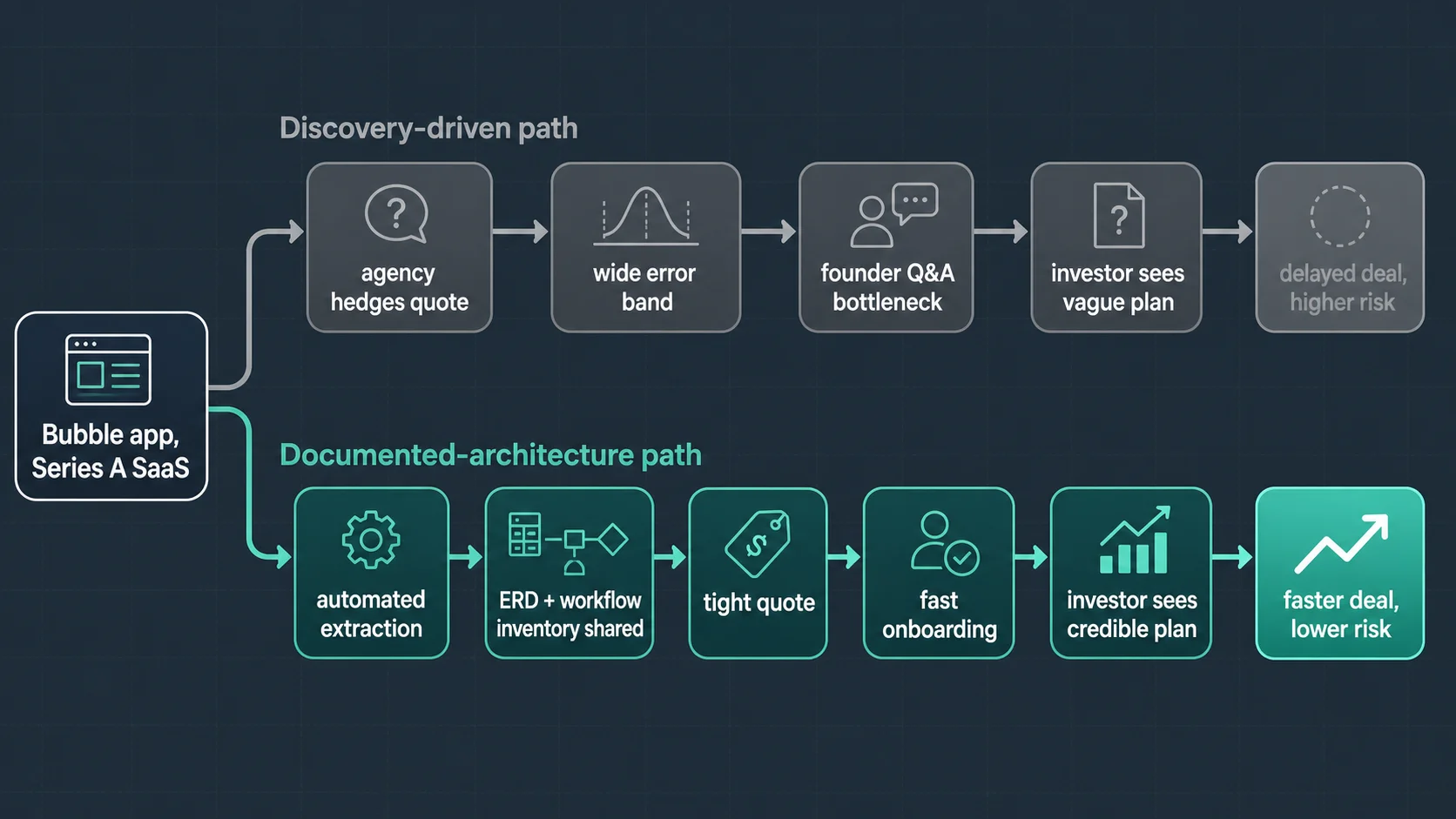
"The board observer did not say 'good migration plan.' They said 'this looks like a company that ships.' I think those are the same sentence in different clothes."
— Composite founder, paraphrased
See the Same Outputs for Your App
Run an extraction on your Bubble app and get the ERD, API spec, workflow inventory, and six other documents agencies use to size migrations. Free for your first project, ten minutes end-to-end.
🚀 Start Free ExtractionWhat This Founder Would Tell Themselves a Year Ago
Asked what they would do differently, the composite founder lands on three things. None of them are technical.
First, run the extraction earlier. Not at the moment the migration becomes urgent — six months before, when it is still optional. The cost of the documentation is the same. The cost of not having it during a Workload Units overage week is the bad version of the conversation we walked through. The founder describes this as "the cheapest insurance I never bought on time."
Second, do not negotiate the first quote. Replace the inputs to it. The instinct of a non-technical or formerly-technical founder is to push back on the timeline directly — "can we do it in four months instead of six?" That conversation rarely moves. Replacing the discovery surface with a documentation pack moves the same number twice as far in half the time, and it does so without burning credibility with the agency.
Third, treat the documentation as a recurring asset, not a one-time export. The ERD and workflow inventory drift as the app evolves. Re-running the extraction on a quarterly cadence keeps the artifacts honest, shortens future onboarding cycles, and gives the founder a continuously up-to-date set of slides for the next investor conversation. The founder's honest failure mode here: they ran the extraction once, used it for the quote, and let it go stale for two months. They would not do that again.
The composite founder freely admits the documentation went stale because they treated it as a deliverable rather than a routine. Two months later, an engineer joined and the founder had to re-explain a workflow that had drifted. Re-extraction takes ten minutes. It is the boring habit they wish they had built earlier.
Frequently Asked Questions
Q. Is this case study a real single founder?
No. It is a composite drawn from multiple founder conversations and engagements we have advised on. We chose to write it as a composite so the patterns are concrete without exposing any single company's cap table, vendor relationships, or exact financials. Names, exact figures, and incidental details are illustrative; the decision sequence and the magnitude of the timeline change reflect what we have repeatedly seen across SaaS migrations off Bubble.
Q. Will my migration also drop from six months to three?
The honest answer is "we do not know your app." The pattern we have seen is that the largest single source of quote variance is discovery work the agency cannot otherwise see. Removing it through documentation tends to compress the quote and tighten the error band. The exact magnitude depends on app complexity, target stack, and team experience. A quote drop of roughly forty to fifty percent in calendar time is consistent with the pattern in this composite, but it is not a guarantee.
Q. How long does the extraction itself take?
For a typical B2B SaaS Bubble app — dozens of data types, hundreds of workflows, around a dozen API integrations — the automated extraction completes in roughly ten minutes. The output is the documentation pack referenced above. The time-consuming step is not the extraction; it is the founder reviewing the outputs and deciding which ones to share with the agency, the engineer, and the investor.
Q. Can I share these outputs with investors directly?
Yes, and the architecture overview plus the ERD are usually the two artifacts that travel best to a board context. We recommend pairing them with a one-page migration timeline derived from the agency's quote, rather than dropping the full nine-document pack into a data room. Most investors want a credible plan, not a complete codebase tour.
Q. What if my app is much larger than the one in this composite?
For larger apps — hundreds of data types, thousands of workflows — the absolute timeline does not collapse to three months, but the proportion of timeline spent on discovery shrinks similarly. The first quote is still hedged against unknowns; the documentation still removes the unknowns. The migration is bigger, but the variance is smaller. Larger apps also benefit more from re-running the extraction quarterly, because drift is faster.
Q. Does this work for non-SaaS Bubble apps?
The mechanism — replacing discovery surface with documented surface — is the same regardless of whether the app is SaaS, marketplace, or internal tool. The economics are different. SaaS apps tend to have more disciplined data models and clearer privacy rules, so the documentation lands cleaner. Marketplace apps usually have heavier integrations surface and benefit disproportionately from the API contract spec. Internal tools often have less discipline around workflows and benefit most from the workflow inventory.
Three Months Is Not Magic — It Is Visibility
- The first quote prices discovery, not migration. A six-month quote on a typical Series A SaaS Bubble app is the rational output of an estimator who cannot see your privacy rules, workflows, and API contracts. Removing the unknowns, not negotiating the timeline, is the move.
- Two outputs do most of the work. The ERD and the backend workflow inventory together account for most of the timeline variance. The other seven extracted documents reduce residual risk and make onboarding self-serve.
- The second-order win is onboarding. The same documentation pack that compresses the agency quote compresses the new-engineer ramp-up curve, because it answers the questions engineers ask in their first week before they have to ask the founder.
- Investors read architecture as competence signal. A documented migration plan changes the implicit question from "do these founders know what they have built" to "is the timeline credible." That shift moves the next conversation faster than any pitch deck slide will.
- Treat the documentation as a recurring asset. Extractions go stale because Bubble apps keep evolving. A quarterly re-run keeps the ERD and workflow inventory honest and saves future founder hours during the next migration, hire, or board update.
Three months is not a faster team. It is a less surprised team. The composite founder's actual edge was not negotiating harder — it was showing up to the conversation with the same map the agency was about to draw, except finished, and accurate, and printed at the right resolution.
Get the Same Documentation This Composite Used
Run Relis on your Bubble app. ERD, API spec, backend workflow inventory, plus six more documents — the same outputs that compressed this composite founder's quote from six months to three. Free for your first project.
🚀 Start Free ExtractionYour Bubble App Has No Export Button — Until Now
Relis extracts your complete Bubble.io architecture automatically. ERD diagrams, DDL scripts, API docs, workflow specs — all in under 10 minutes.
Your Bubble App Has No Export Button — Until Now
Relis extracts your complete Bubble.io architecture automatically. ERD diagrams, DDL scripts, API docs, workflow specs — all in under 10 minutes.